
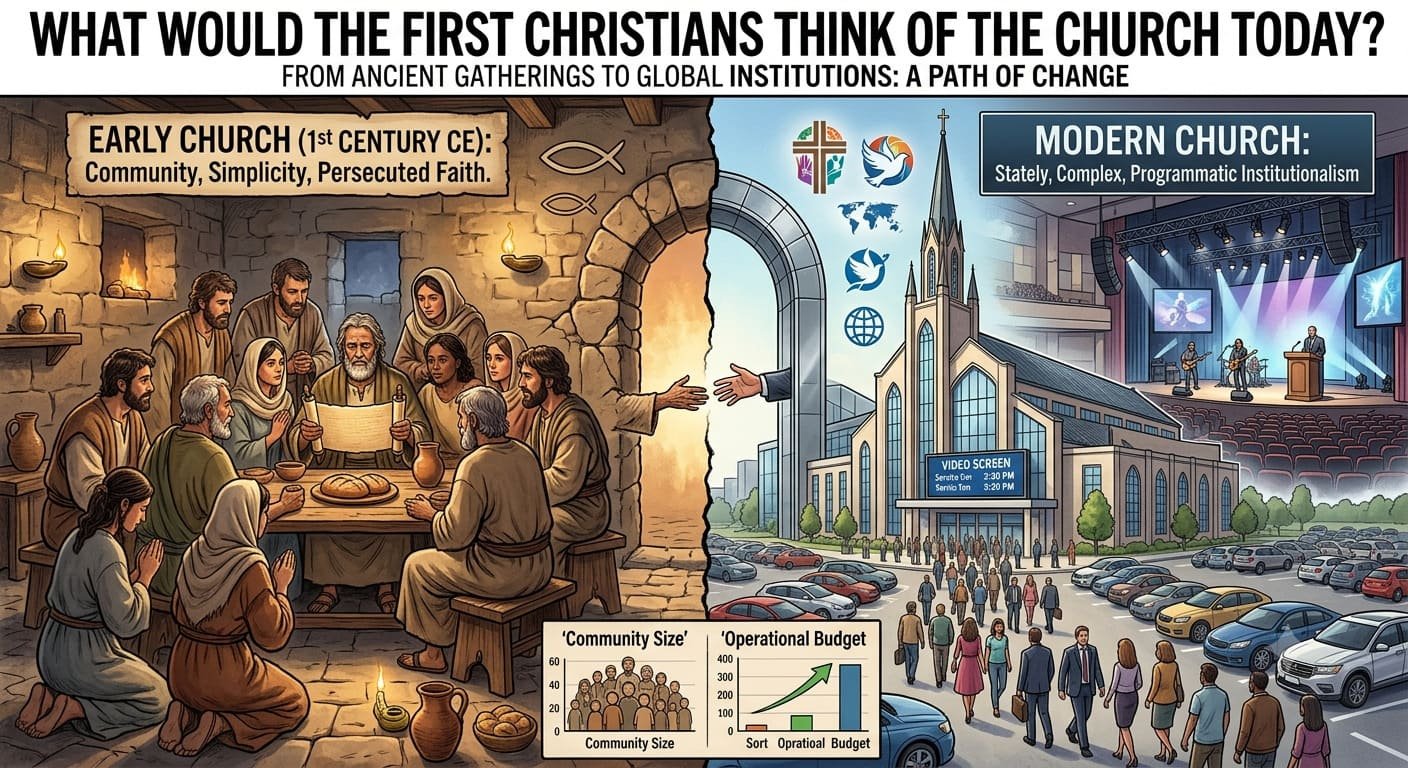
What Would the First Christians Think of the Church Today?
The first Christians shared everything, met in secret, and risked their lives for their faith. A look at what they might make of the church in 2026, and what that comparison is worth.
<p>It is a question worth sitting with honestly: if someone from the earliest Christian communities; someone who worshipped in secret, who shared everything they owned, who risked their life simply by calling themselves a follower, walked into a modern megachurch on a Sunday morning, what would they make of what they saw?</p><p>
Not as a gotcha. As a genuine question. Because the distance between those two worlds is worth examining carefully.</p><p><b>What the early church actually looked like</b></p><p>
The first Christian communities were small, hidden, and built almost entirely around mutual survival. They met in living rooms and courtyards, not purpose-built buildings. Leadership was local and personal. Resources were pooled, not as a theological experiment, but because many members faced genuine poverty and social exclusion for their faith.</p><p>
Early texts describe communities where property was sold to meet the needs of those who had none. The measure of a leader was not their influence or income, but their willingness to suffer alongside the people they served. Many of them did suffer. Imprisonment, social ruin, and in some cases execution were real risks attached to membership.</p><p>
The message they carried was deliberately uncomfortable. It asked for a reordering of loyalties, a letting go of status, and a commitment to people the surrounding culture had written off. It was not designed to attract the powerful or the comfortable. In many ways, it was designed to unsettle them.</p><p><b>How some of that has changed</b></p><p>
To be fair, the church has never been a single, unchanging institution. Within a few centuries of its founding, Christianity became the official religion of the Roman Empire; a transformation that brought resources, influence, and all the complications that come with both. The tension between institutional power and grassroots faith is not new. It has been running through Christian history for nearly two thousand years.</p><p>
But something specific has accelerated in recent decades, particularly in certain corners of global Christianity, and it is worth naming directly.</p><p>
A significant and visible strand of modern church culture operates on a model that early Christians would find genuinely difficult to recognise. The gathering is a production, professional lighting, curated sound, slick branding. The pastor is a platform, protected by green rooms and managed by communications teams. Spiritual experience is packaged and sold: books, courses, conferences with tiered ticket pricing, prophetic consultations available for a fee.</p><p>
And then there is the prosperity gospel, the teaching that financial giving is a spiritual investment strategy, that faith rightly applied produces material wealth, that God's favour can be, in some meaningful sense, unlocked through a financial seed. This is not a fringe phenomenon. It has tens of millions of adherents across multiple continents.</p><p>
Early Christian writing was surprisingly direct on this specific point. One of the oldest post-biblical texts, the Didache, offered a blunt test for identifying false teachers: if they ask for money, treat that as a warning sign. The New Testament itself contains one of its sharpest rebukes for a man who tried to purchase spiritual power; an act the early church found so offensive it named the sin after him.</p><p><b>What this is not saying</b></p><p>
This is not an argument that all modern Christianity is corrupt or commercial. The majority of the world's Christians attend small, modest, community-rooted congregations that look far more like the early church than a megachurch campus does. Across the global south especially, Christianity is still largely a religion of the poor, the marginalised, and the persecuted, people for whom the faith carries real personal cost.</p><p>
Nor is it an argument that institutions, buildings, or professional leadership are inherently wrong.</p><p>
Communities need structures to survive across generations. The question is not whether the church should have resources, but what those resources are for, and who they serve.</p><p><b>The tension worth sitting with</b></p><p>
What the early Christian perspective does offer is a useful mirror. Not a perfect one, the early church had its own failures, its own power struggles, its own moments of profound hypocrisy. But its core instincts were pointed in a specific direction: away from accumulation, toward the poor.</p><p>
Away from spectacle, toward presence. Away from a message designed to comfort the comfortable, toward one that asked something real of everyone it touched.</p><p>
When that instinct is compared honestly against a model where the quality of the worship experience determines which church people choose, where the pastor's personal brand is the primary draw, and where spiritual goods are sold to people searching for something they cannot name, the distance is hard to ignore.</p><p>
The most famous moment in the Gospels involving a religious marketplace is not subtle about where Jesus stood on the question. Tables were overturned. Coins were scattered. The place of prayer, he said, had become something else entirely.</p><p>
Whether that image applies to any specific church today is a question each community has to answer for itself. But it is, perhaps, a question worth asking.</p>
Date
Featured
Verified
Community Engagement
Community
⚔️
📝
👁
🎯
📊
✏️
Comments ()
Sign in to join the conversation
Sign InNo comments yet. Be the first to share your thoughts!
Comments will be loaded here...