
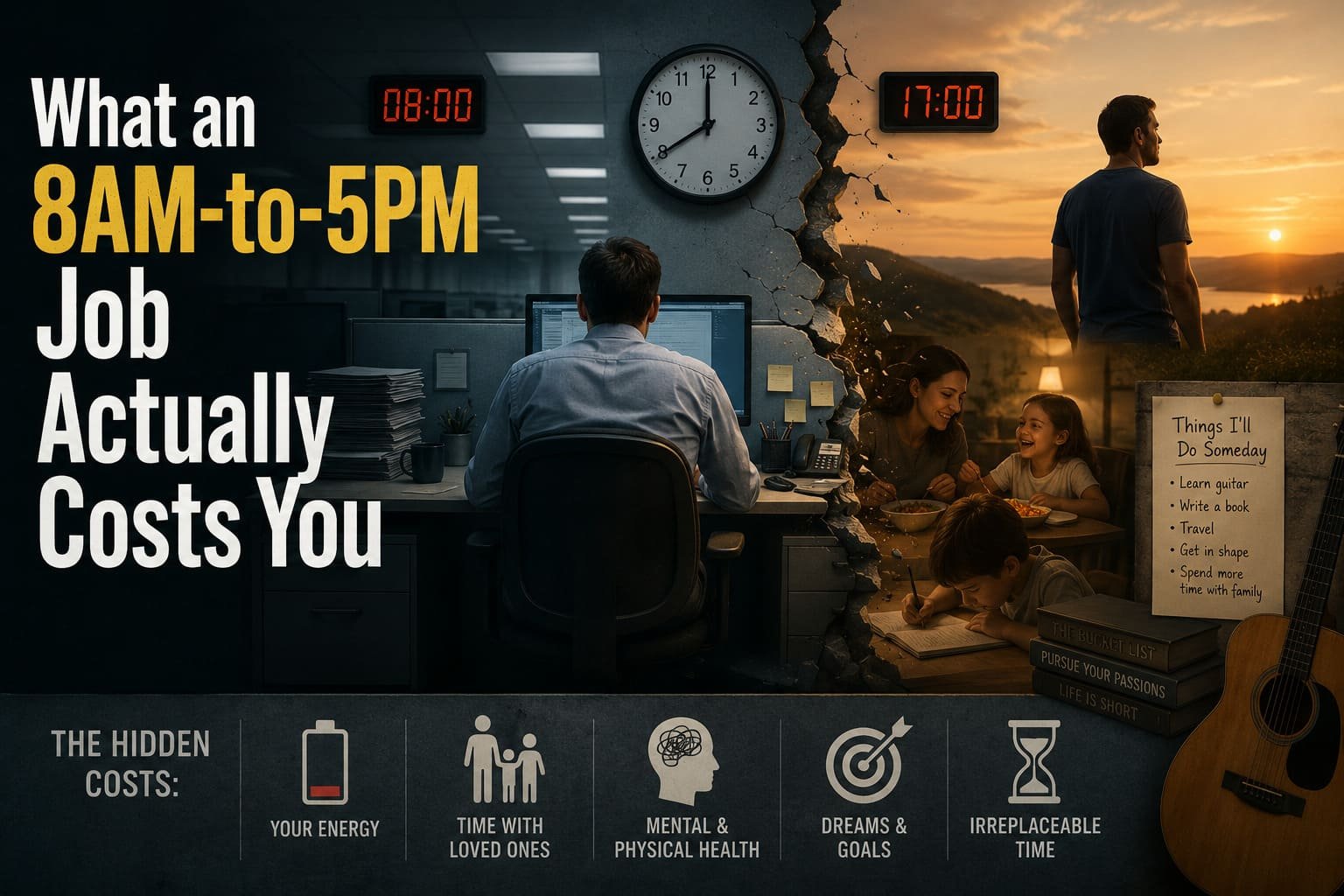
What an 8AM-to-5PM Job Actually Costs You
It's not a prison, and it's not a war, it's an arrangement. A close look at what the working week actually costs, and the small rebellions that make it bearable.
<p>Let's be honest about what a 9-to-5 job is.</p><p>
It is not a prison. It is not a war. It is an arrangement, a quiet, centuries-old contract that trades the finite currency of your waking hours for the promise of security. This is not a story about lazy people or greedy companies. It is a story about the space between the alarm clock and the paycheck, and the small, fierce rebellions of the heart that keep us alive inside it.</p><p><b>The morning begins with a quiet kind of violence</b></p><p>
The alarm does not ask how you feel. It simply commands. You go through the motions, shower, coffee, the right clothes, not because you want to, but because the world demands a specific costume before it will accept your labour. You step outside in the half-light and join a river of other bodies, all moving in the same direction. A small part of a machine too large to see the edges of.</p><p>
This is where the first ache begins: the feeling of being reduced. At work, you are not the person who loves their child, or dreams of mountains, or writes poetry in their head. You are a job title. An email address. A pair of hands performing tasks until the clock reaches a certain number.</p><p><b>Time stops moving the way it should</b></p><p>
The work itself is rarely the real problem. It can be tedious, even meaningless at times, but it's usually just there, a task to finish, a problem to solve. The real pain is the stretch of hours in between. You glance at the clock. 10:15. You glance again. 10:17. Time stops flowing and starts dripping. You are serving a sentence for a crime you never committed.</p><p>
By the afternoon, a fog sets in. The lights hum, the air goes stale, and somewhere underneath it all, a quiet question surfaces: is this it? Is this the life I was promised?</p><p>
And then the commute home, and the particular exhaustion that comes not from physical effort, but from a full day spent being a version of yourself that requires constant maintenance.</p><p><b>But we are not just cogs</b></p><p>
This is where the story turns. Because somewhere inside all of this, we keep finding the light in the cracks. Life does not happen outside these walls. It happens inside them, in the smallest moments. A shared laugh over a terrible cup of coffee. A text to someone you love that just says <i>can't wait to see you</i>. The secret world behind your eyes, where you're planning a garden, building a story, remembering the smell of rain after it falls.</p><p>
These are the tiny rebellions, the moments stolen back from the machine and quietly reclaimed for yourself.</p><p><b>The scaffolding holds something worth having</b></p><p>
Eventually, you start to see the job differently. Not as the point of your life, but as the structure that holds the rest of it up. It pays for the house, the groceries, the music lessons, the small joys that actually make a life worth living. It is the price of admission to everything that matters more than the job itself.</p><p>
And somewhere in that arrangement, you learn things you didn't expect to learn. The beauty of a thirty-minute lunch break in the sun. The way the hour after work suddenly feels like treasure. The instinct to guard your weekends like sacred ground.</p><p><b>The triumph underneath the grind</b></p><p>
The pain of the working week is real. It is the quiet tragedy of a life that can feel, some days, unlived. But the triumph sitting right beside it is just as real, the simple, stubborn refusal of the human spirit to be fully extinguished by routine.</p><p>
We are not our jobs. We are the people who endure them, and then go home and actually live. We dream while doing the dishes. We plan our futures while filing reports. We love fiercely in the small hours we manage to reclaim.</p><p>
In the grinding repetition of it all, something in us gets polished rather than worn down. We become people who understand, in a way we never could have before, the true value of a single free hour.</p><p><b><i>
The alarm will ring again tomorrow. We will get up. We will put on the costume. We will join the river.</i></b></p><p><b><i>
But we carry our secret worlds with us. And that, quietly, is the most powerful thing we have.</i></b></p>
Date
Featured
Verified
Community Engagement
Community
⚔️
📝
👁
🎯
📊
✏️
Comments ()
Sign in to join the conversation
Sign InNo comments yet. Be the first to share your thoughts!
Comments will be loaded here...