
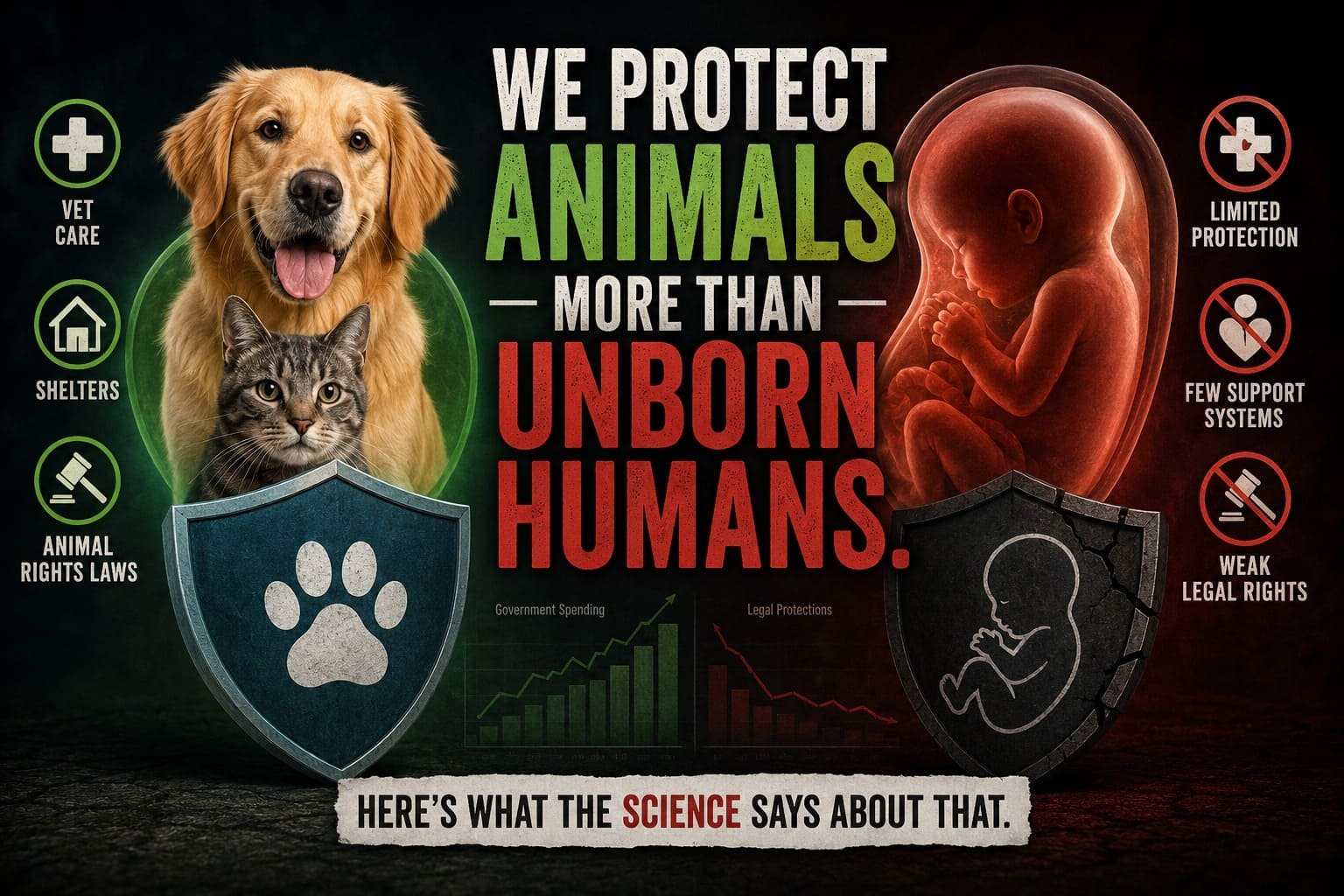
We Protect Animals More Than Unborn Humans. Here's What the Science Says About That.
The world spends $143 billion a year protecting endangered animals. It also performs 73 million abortions annually. Here is what the biology says about both without the political framing.
<p>Every year, the world mobilises extraordinary resources to protect endangered species. Governments pass legislation. Charities raise billions. International treaties are signed. When a species faces extinction, we treat it as a crisis demanding urgent action. In the same year, approximately 73 million abortions are performed globally, roughly 200,000 every single day, accounting for 29 percent of all pregnancies worldwide. <a href="https://cites.org/eng/news/pr/united-nations-explores-financing-future-of-wildlife-for-world-wildlife-day-2025" target="_blank" rel="noopener noreferrer" style="background-color: rgb(255, 255, 255); font-family: Exo, sans-serif;">CITES</a></p><p>
The question this piece is asking is not a political one. It is a biological one: what exactly are we protecting, and what are we not, and does the science support that distinction?</p><p><b>What the numbers look like side by side</b></p><p>
Annual global investment in biodiversity conservation currently stands at $143 billion, with calls from the United Nations to increase that to $824 billion per year to adequately protect nature. WWF alone invested over $395 million in conservation programmes in its most recent financial year.</p><p>
These are serious, sustained, well-funded efforts, and many of them have worked. The US Endangered Species Act, over its 50-year history, has helped protect 99 percent of listed species from extinction. The Iberian lynx, once on the brink of disappearing entirely, now numbers over 2,000 adults following two decades of international conservation collaboration, hailed as the greatest recovery of a cat species ever achieved.</p><p>
These are genuine achievements worth celebrating. The question is what standard of life we applied to justify them, and whether we apply that same standard consistently.</p><p>
<b>What biology says about unborn human life</b><b></b></p><p>
At the moment of fertilisation, a genetically distinct human organism comes into existence. Its DNA is neither the mother's nor the father’s, it is a new, individual human genetic profile that has never existed before. That is not a philosophical claim. It is documented in every serious embryology textbook currently used in medical education.</p><p>
By approximately six weeks, a heartbeat is detectable. By six to eight weeks, early brain activity begins. By twelve weeks, the fetus has fingers, reflexes, and measurable movement. By twenty weeks, there is documented evidence of pain response. These findings are not contested in the scientific literature.</p><p>
So by every measurable biological standard, distinct DNA, heartbeat, brain activity, physical development, pain response, an unborn human at these stages of development is a living, individual human organism.</p><p>
<b>The comparison that needs to be made honestly</b><b></b></p><p>
The case for protecting endangered animals rests on solid biological ground: they are living organisms capable of suffering, with their own biological individuality. We protect them because science shows they matter.</p><p>
Now apply the same framework to an unborn human. Distinct genetic identity from conception. Heartbeat by six weeks. Brain activity shortly after. Pain response by twenty weeks. By the biological criteria we use to justify protecting animals and in several cases, earlier and more completely than many species we actively campaign to save the unborn human qualifies.</p><p>
Conservation efforts mobilised to bring the Sombrero ground lizard from fewer than 100 individuals to over 1,600 in six years are rightly celebrated. The Iberian lynx recovery is called one of the greatest wildlife achievements in history. These are living organisms with heartbeats, pain responses, and biological individuality and we protected them with billions of dollars and decades of sustained effort.</p><p>
In the United States alone, an estimated 862,320 abortions were performed in 2024. Globally, the figure amounts to approximately 200,000 per day, a number that, by any comparative measure, exceeds every other cause of death worldwide. <a href="https://cites.org/eng/news/pr/united-nations-explores-financing-future-of-wildlife-for-world-wildlife-day-2025" target="_blank" rel="noopener noreferrer">CITES</a><a href="https://www.animalsaroundtheglobe.com/11-creative-ways-the-world-is-financing-wildlife-conservation-in-2025-6-342180/" target="_blank" rel="noopener noreferrer">Animals Around The Globe</a></p><p>
<b>Where the language obscures the biology</b><b></b></p><p>
The phrase "cluster of cells" is technically true of every living organism at every stage of development, including every adult human being reading this article. Using it specifically to describe an embryo is not a scientific statement. It is a framing choice, designed to make a philosophical position feel more biologically grounded than it is.</p><p>
Similarly, describing a heartbeat at six weeks as "potential life" is not consistent with how we apply the word life anywhere else in biology. A heart beating is not potential function. It is function.</p><p>
None of this means the conversations about bodily autonomy, access to healthcare, poverty, or the circumstances of unwanted pregnancy are not real and serious. They are. But those are philosophical and policy conversations, and they deserve to be had honestly, starting from accurate biology rather than language engineered to soften it.</p><p>
<b>The consistency question</b><b></b></p><p>
If the standard for deserving protection is biological life, individual existence, and the capacity to develop and suffer, then that standard should be applied without selective blindness.</p><p>
A society that commits $143 billion annually to protect animal species on the basis of their biological life, while performing 73 million abortions per year on organisms that meet the same biological criteria, is not applying a consistent standard. It is applying different standards to different categories of life, and the category receiving less protection is the human one.</p><p>
That is not a conservative argument or a progressive argument. It is a question about intellectual consistency, and it deserves a straight answer.</p>
Date
Featured
Verified
Community Engagement
Community
⚔️
📝
👁
🎯
📊
✏️
Comments ()
Sign in to join the conversation
Sign InNo comments yet. Be the first to share your thoughts!
Comments will be loaded here...