
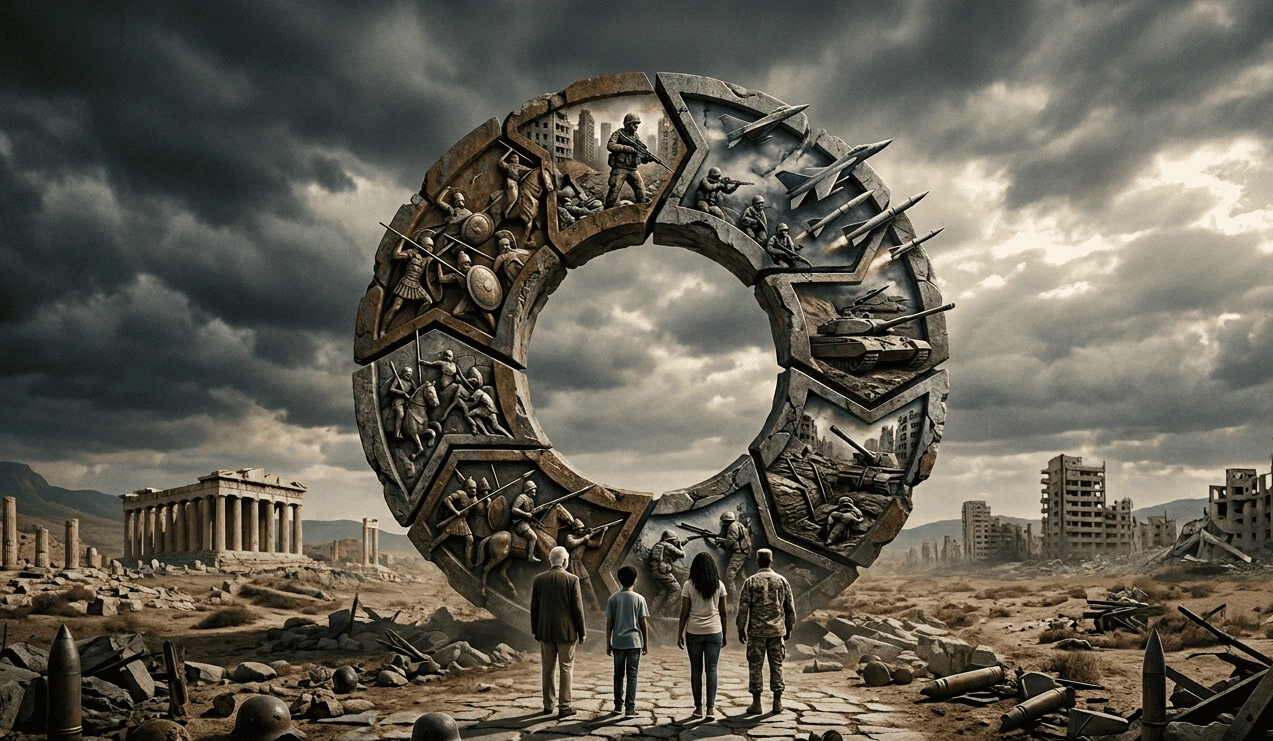
The Unbroken Cycle: Why Humanity Cannot Outgrow War
The weapons change every generation. The instincts behind them do not. A clear-eyed look at why war keeps finding humanity, and what that means for the rest of us.
<p>Every generation inherits the same promise: that the last war was the worst one, and that surely, this time, we have learned enough to stop. Every generation eventually breaks that promise.</p><p>This is not a failure of intelligence or morality. The weapons change, from bronze spears to guided drones but the instincts driving the hands that wield them have not changed in hundreds of thousands of years. To understand why war keeps finding us, you have to go back much further than any history book.</p><p><b>We were never really strangers to this</b></p><p>Long before nations existed, before borders were drawn or flags were sewn, human beings survived in small, tight-knit groups. Your group was everything; your food, your protection, your identity. Everyone outside it was a potential threat.</p><p>That wiring never left us.</p><p>Today we call it tribalism. In peacetime it looks relatively harmless, sports rivalries, political arguments, an instinctive distrust of people who speak differently or pray differently. But apply enough pressure to a society; scarcity, fear, humiliation, and that same wiring activates completely. The stranger across the border stops being a person and becomes a symbol. Violence stops being a crime and starts feeling like a duty. This is not unique to any culture or century. It is the oldest software running on the newest hardware.</p><p><b>The trap no country can escape</b></p><p>Imagine you are a small nation. You feel threatened by your neighbour, so you build up your defences; purely, you insist, for protection. Your neighbour watches this and thinks: why are they arming? They must be planning something. So they arm too. You see them arming and conclude your fears were justified all along. And so it goes, round and round, until a single miscalculation; a border skirmish, a bad intelligence report, a leader under domestic pressure tips the whole thing over.</p><p>Political scientists call this the security dilemma. No one in this story is necessarily evil. Everyone is simply afraid, and acting rationally on that fear. The tragedy is that rational behaviour, at scale, can produce catastrophic outcomes.</p><p>This is the world that every nation lives in. There is no global referee with the power to guarantee anyone's survival. Every country, ultimately, is on its own.</p><p><b>The earth itself keeps score</b></p><p>Ideas change. Religions rise and fall. Empires dissolve. But the physical world stays exactly where it is.</p><p>Wars are rarely really about the reasons given in speeches. They are about rivers, coastlines, mountain passes, and the ground beneath which oil or copper or fresh water sits. They are about who controls the narrow strait through which a third of global trade must pass. They are about the flat, open plains that have made Eastern Europe a battlefield for centuries, because there is nothing between an invading army and the capital except distance.</p><p>As long as resources are finite and unevenly spread across the earth, there will always be a structural reason for one group to want what another group has. Geography does not negotiate.</p><p><b>What this means for the rest of us</b><b></b></p><p>None of this is comfortable to sit with. It would be easier to believe that war is a relic; a symptom of ignorance that education and prosperity will eventually cure. The evidence, unfortunately, does not support that.</p><p>War is not a glitch in the human story. It is a recurring feature of it, emerging wherever tribal fear, geographic pressure, and political miscalculation converge at the same moment.</p><p>But here is the part that matters: knowing this is not the same as accepting defeat. The periods of relative peace humanity has managed to build, however fragile, however imperfect were not accidents. They were the result of enormous, sustained effort by people who understood exactly how close the edge always is.</p><p>Peace is not a destination. It is maintenance work. And it falls, as it always has, to the generation currently alive.</p>
Date
Featured
Verified
Community Engagement
Community
⚔️
📝
👁
🎯
📊
✏️
Comments ()
Sign in to join the conversation
Sign InNo comments yet. Be the first to share your thoughts!
Comments will be loaded here...