
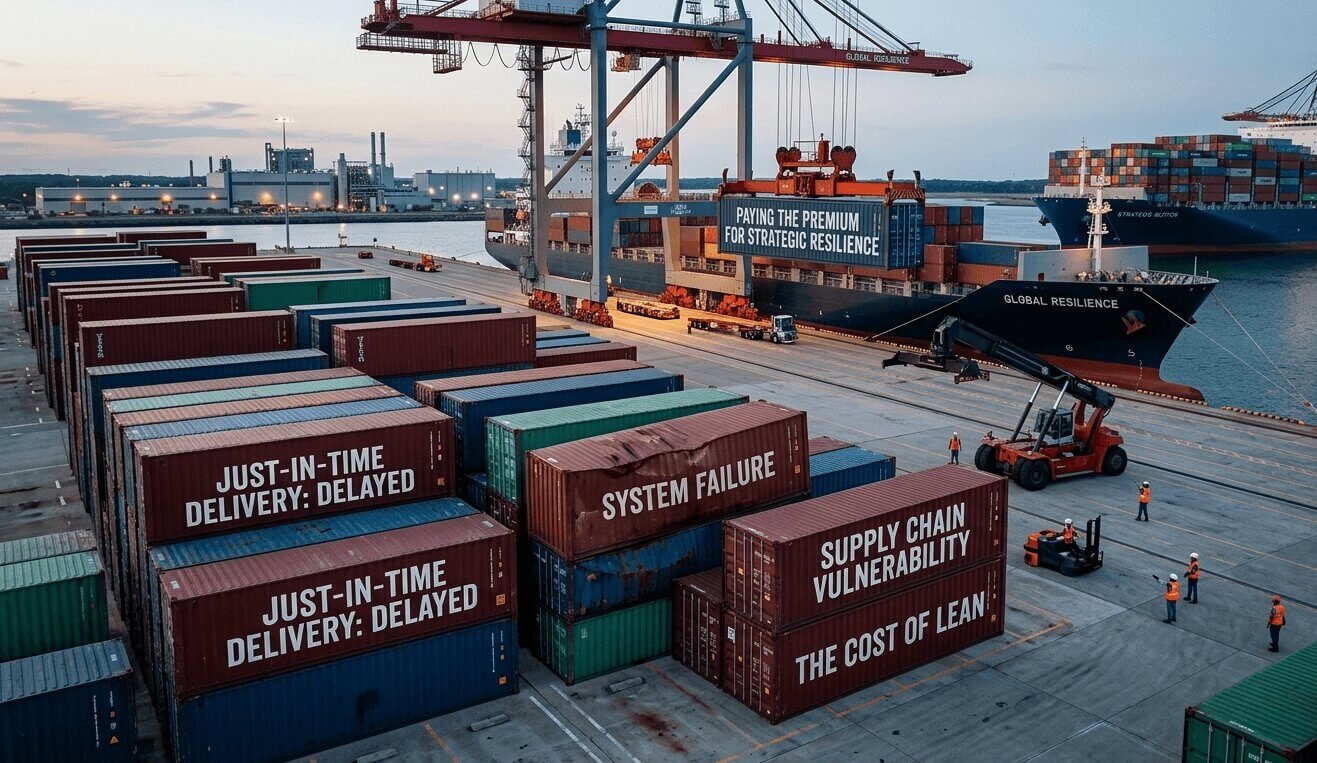
The Death of "Just-in-Time": Why the Global Economy is Paying the Premium for Strategic Resilience
Just-in-time supply chains were built for a stable world. That world is harder to find. How global firms are rebuilding for resilience and what it's costing them.
<p>For much of the last four decades, global supply-chain strategy prioritized efficiency and cost optimization, largely through lean and just-in-time inventory models. The gold standard of manufacturing and retail was a system designed to minimize holding costs by ensuring raw materials arrived at the factory floor exactly when needed. It was an elegant framework, but one that performed best in environments with relatively predictable transportation, supplier reliability, and demand patterns.</p><p>By 2026, many firms view that predictability as significantly diminished. Faced with sustained tariff volatility, maritime chokepoints, and climate-induced transit bottlenecks, the global economy is executing a structural pivot. The pursuit of the lowest possible unit cost is increasingly being weighed against the harder-to-quantify value of network resilience.</p><p><b>From linear chains to modular orchestration</b></p><p>The transition away from just-in-time is not merely a matter of companies buying more warehouse space to stockpile inventory. That is a brute-force tactic that ties up massive amounts of working capital. Instead, forward-thinking enterprises are redesigning their supply networks away from fragile, linear chains toward more flexible, modular ecosystems.</p><p>Where a legacy supply chain ran in a straight line from a single source through a central factory to a fixed shipping lane, the 2026 model distributes across multi-tier suppliers, regional micro-hubs, and algorithmic rerouting. Leading manufacturers, global logistics providers, and large retailers using AI-assisted planning, digital twins, and advanced control tower systems are shifting production volumes across distributed nodes in near real time. Adoption of these capabilities varies significantly by industry and company size, but the direction of travel is consistent.</p><p><b>The geopolitical trade corridors of 2026</b></p><p>This macroeconomic realignment is redrawing the global infrastructure map. Western alliances and major economic blocs are investing heavily in secure, land-based logistical corridors to reduce dependence on vulnerable maritime transit routes.</p><p>The most prominent example is the Lobito Corridor; a 1,300-kilometre rail network backed by the United States, the European Union, and regional development banks, connecting the mineral-rich Copperbelt regions of Zambia and the Democratic Republic of Congo to the Atlantic port of Lobito in Angola. Its objectives include reducing transport costs, improving export efficiency, and securing western-oriented access to critical minerals like copper and cobalt.</p><p>Running in parallel, the TAZARA modernization project is upgrading the historic rail link connecting Zambia to Tanzania's Dar es Salaam port, maintaining an eastern-oriented mineral export corridor backed by separate development interests. Meanwhile, nearshoring hubs in Mexico and Eastern Europe are concentrating manufacturing closer to end markets, reducing trans-oceanic shipping exposure for critical automotive and industrial components.</p><p><b>The new financial reality: the inflationary tax of resilience</b></p><p>While this structural shift helps insulate supply chains from disruption, it carries a steep macroeconomic price. Building redundant supplier networks, maintaining multi-tier regional inventory buffers, and investing in localized infrastructure are capital-intensive maneuvers that can increase operating costs and contribute to inflationary pressure in certain sectors, though the extent varies, and automation investments may offset some of those costs over time.</p><p>What is broadly agreed upon is that tariffs are no longer viewed by financial officers as temporary political standoffs. Across sectors including US-China trade, critical minerals, automotive manufacturing, and semiconductors, they are increasingly modeled as persistent strategic risks within corporate P&L statements.</p><p><b>The operational takeaway</b></p><p>For economists, enterprise executives, and corporate strategists, the emerging consensus of mid-2026 points in one direction. Optimizing purely for the lowest unit cost, at the expense of network visibility and redundancy, has proven to be a strategic vulnerability. In a more volatile world, competitive advantage increasingly belongs to organizations that can absorb systemic shocks, reroute logistics quickly, and maintain continuous delivery to their markets.</p><p>That calculus is not yet universal. But among firms that have experienced major supply chain failures in recent years, it is becoming difficult to argue otherwise.</p>
Date
Featured
Verified
Community Engagement
Community
⚔️
📝
👁
🎯
📊
✏️
Comments ()
Sign in to join the conversation
Sign InNo comments yet. Be the first to share your thoughts!
Comments will be loaded here...