
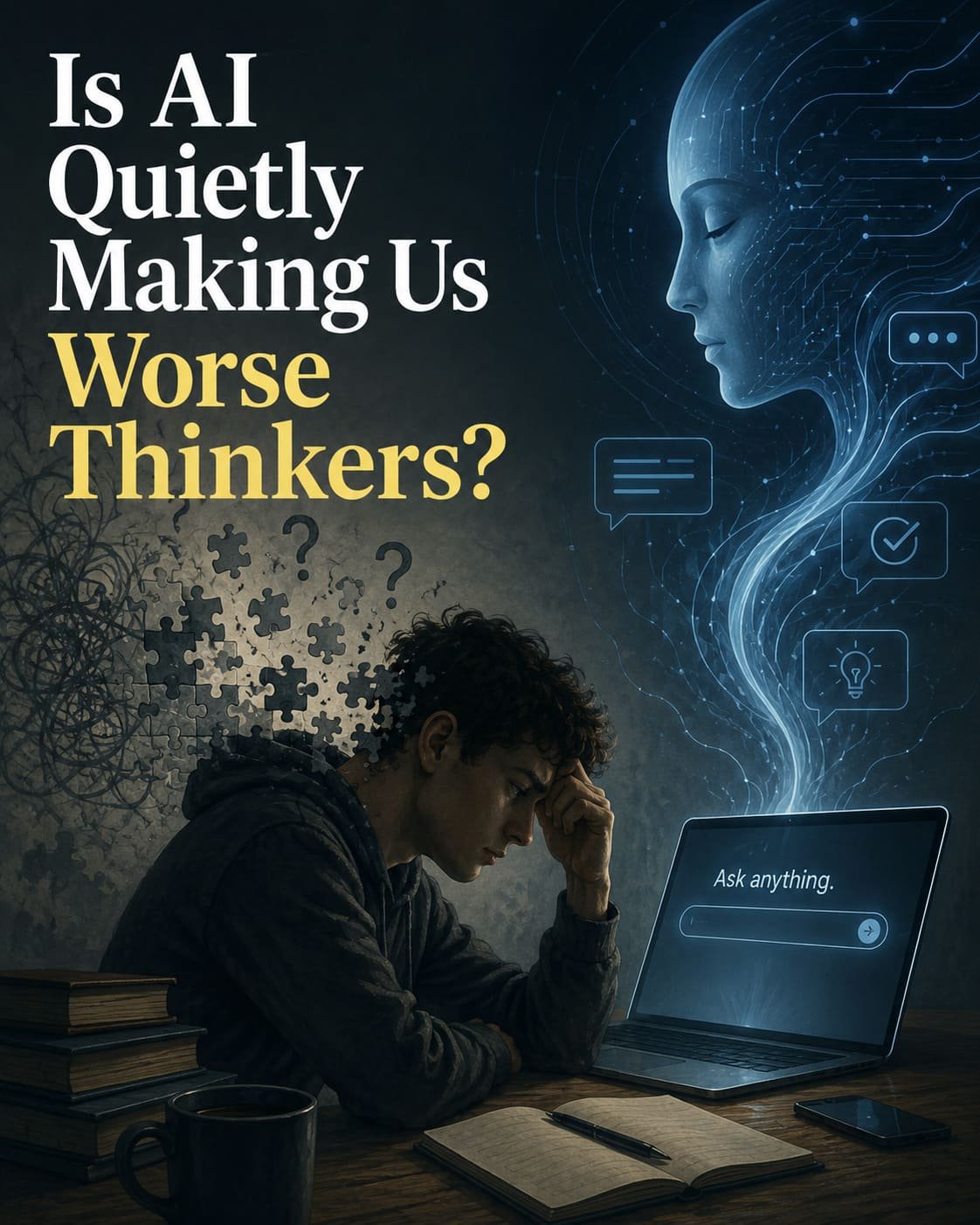
Is AI Quietly Making Us Worse Thinkers?
New research shows AI tools can make us feel sharper while quietly eroding the skills underneath. A look at what the science actually says about cognitive offloading, and how to use these tools without losing your edge.
<p>For most of modern history, new technology made a fairly simple promise: it would take the boring, repetitive parts of thinking off your plate so you could spend your energy on the interesting parts. The calculator freed you from long division. GPS freed you from memorising routes. Search engines freed you from needing to remember everything.</p><p>
AI is breaking that pattern, and researchers are starting to find out why.</p><p><b>The struggle was the point</b></p><p>
Learning something difficult has never felt pleasant. Wrestling with a confusing problem, holding two conflicting ideas in your head at once, spending an evening debugging something that refuses to work, none of that feels good while it's happening. But that discomfort is doing something important. It's the actual mechanism by which understanding gets built.</p><p>
When researchers at MIT's Media Lab studied people writing essays with and without AI assistance, they found something striking. Participants who wrote without any AI or search tools showed stronger, more widespread brain activity in regions linked to memory, creativity, and self-awareness. Those who used ChatGPT showed activity patterns suggesting they were following and accepting AI suggestions rather than generating and organising their own ideas. <a href="https://brainmindsociety.org/posts/the-cognitive-costs-of-chatgpt-understanding-mits-viral-study" target="_blank" rel="noopener noreferrer">Brainmindsociety</a></p><p>
The more concerning part came later. When some of the AI-assisted participants were asked to write the same kind of essay again, this time without any help, their performance measurably dropped compared to people who'd never used AI at all. The researchers gave this effect a name: cognitive debt. You can borrow against your own thinking, but eventually the bill comes due. <a href="https://brainmindsociety.org/posts/the-cognitive-costs-of-chatgpt-understanding-mits-viral-study" target="_blank" rel="noopener noreferrer">Brainmindsociety</a></p><p><b>The confidence trap</b></p><p>
Here's the part that should genuinely worry you: people using AI assistants didn't feel like they were getting worse. In several studies, the opposite happened, their confidence in their own abilities actually increased, even as their underlying skills quietly eroded.</p><p>
That disconnect shows up across fields. A widely cited study found doctors who relied on AI assistance got worse at independently detecting cancer over time. The tool produces a polished, confident-looking answer, and it's easy to absorb that polish as evidence of your own growing mastery, when really you've just been watching someone else's reasoning and nodding along. <a href="https://news.mit.edu/2026/consequences-of-relying-on-ai-for-accurate-news-0609" target="_blank" rel="noopener noreferrer">MIT News</a></p><p>
The uncomfortable truth is that catching an AI's mistake requires you to already understand the subject well enough to know it's wrong. If the tool is what's preventing you from building that understanding in the first place, you end up dependent on something you can no longer evaluate.</p><p><b>This isn't new, but the scale is</b></p><p>
To be fair, this isn't an entirely novel problem. Researchers have studied "deskilling" for decades, from calculators weakening mental arithmetic to GPS dulling our sense of direction. Offloading mental effort onto tools is something humans have always done a shopping list is technically a form of cognitive offloading too. <a href="https://news.mit.edu/2026/consequences-of-relying-on-ai-for-accurate-news-0609" target="_blank" rel="noopener noreferrer">MIT News</a></p><p>
What's different with AI is the breadth. A calculator only ever touched arithmetic. GPS only ever touched navigation. Generative AI reaches into writing, reasoning, coding, analysis, and decision-making all at once, nearly every domain where humans build expertise through repeated, effortful practice. Researchers studying this pattern describe a feedback loop: the more fluently AI solves a problem for you, the more tempting it becomes to delegate the next one too, gradually atrophying the very capacity you'd need to solve it yourself. <a href="https://arxiv.org/pdf/2603.26707" target="_blank" rel="noopener noreferrer">arxiv</a></p><p><b>It isn't all bad news</b></p><p>
Not every study tells the same grim story, and it would be dishonest to suggest otherwise. One recent MIT study found people were significantly better at spotting fake news while actively using an AI chatbot to help them, proof that, used the right way, these tools genuinely can sharpen judgment rather than dull it. <a href="https://news.mit.edu/2026/consequences-of-relying-on-ai-for-accurate-news-0609" target="_blank" rel="noopener noreferrer">MIT News</a></p><p>
The difference seems to come down to how the tool is used. Leaning on AI as a second opinion, after you've formed your own view, tends to help. Leaning on it as a replacement for forming a view in the first place tends to hurt. The line between those two is thinner, and easier to cross, than most people realise.</p><p><b>What to actually do about it</b></p><p>
None of this means avoiding AI tools entirely, that ship has sailed, and these tools genuinely are useful. It means being deliberate about where you let them in.</p><p>
Draft your own first attempt before you ask for help. Try to solve the problem in your head before reaching for a search bar. Treat the AI's answer as a second opinion to interrogate, not a verdict to accept. The friction you're tempted to skip is, frustratingly, the exact thing your brain needs in order to actually learn.</p><p>
The tools aren't going anywhere. The question worth sitting with is which parts of your own thinking you're willing to quietly hand over and whether you'll still recognise the gap once it's gone.</p>
Date
Featured
Verified
Community Engagement
Community
⚔️
📝
👁
🎯
📊
✏️
Comments ()
Sign in to join the conversation
Sign InNo comments yet. Be the first to share your thoughts!
Comments will be loaded here...