
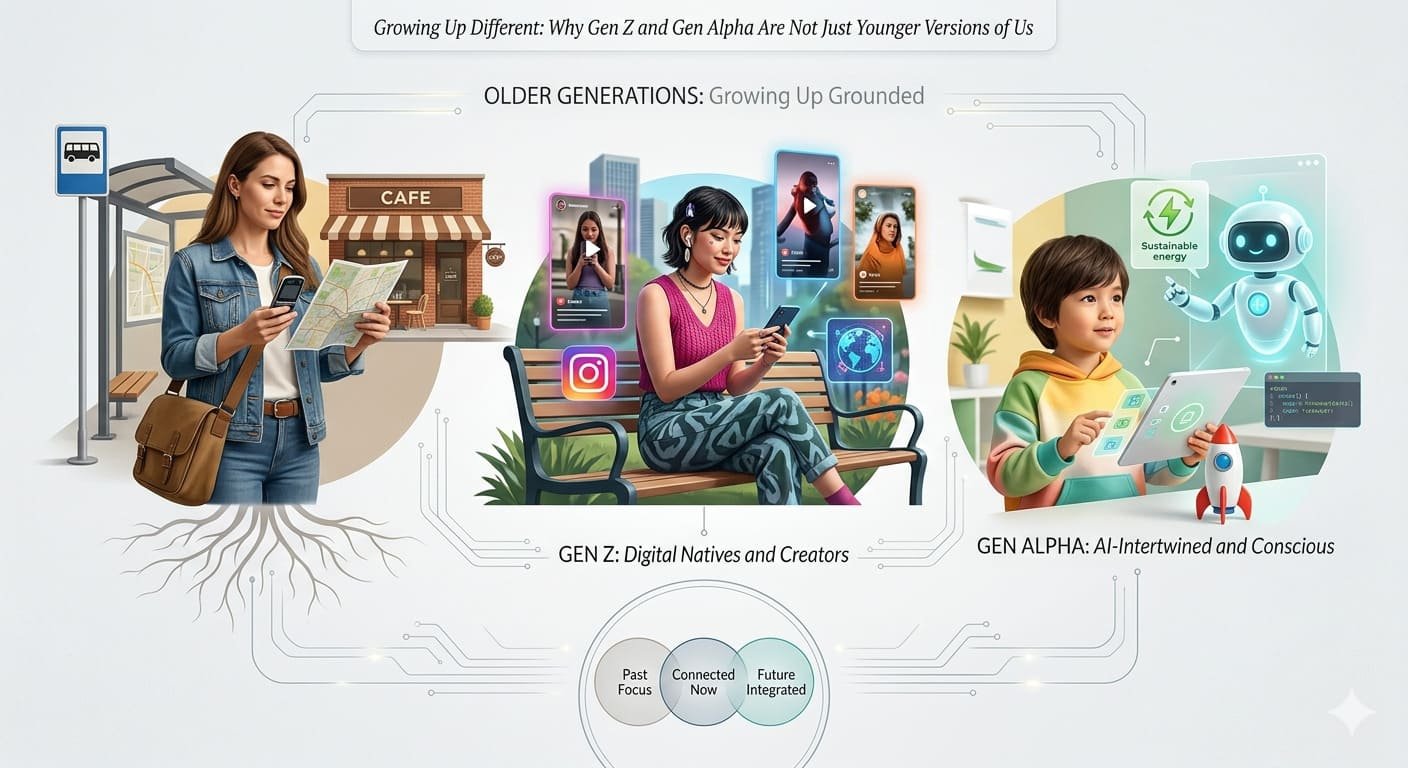
Every older generation looks at the young and sees a different species. That's nothing new. But something genuinely distinct is happening with the generation currently in their teens and the one just arriving in classrooms. This isn't just a gap in taste or values. It's a gap in the basic structure of how they experience the world.
Technology isn't a tool for them; it's the air
For most adults alive today, technology arrived into an already formed life. You grew up, and then computers appeared. Then the internet. Then smartphones. You adopted each one and adjusted.
For Generation Z, that shift happened during childhood. For Generation Alpha; born from around 2010 onwards, there was no shift at all. They arrived into a world where screens, voice assistants, and instant connectivity were simply part of the furniture. Not a new room added to the house. The house itself.
This changes more than behaviour. It changes how the mind organises reality. An Alpha child moves between a virtual classroom, an AI tutor, a group chat with friends, and a physical playground without experiencing these as separate worlds. They are just different places within the same continuous experience. The concept of "going online" is as foreign to them as the concept of "going to colour" would be to us.
Identity is no longer shared; it's assembled
Previous generations grew up inside a cultural monoculture. The same television programmes, the same chart music, the same films everyone watched on the same weekend. There was a shared cultural reference point that gave people a common language across a whole generation.
That is largely gone. Gen Z and Alpha don't consume culture, they curate it. Each person builds a highly specific personal world from thousands of niche subcultures, fandoms, gaming universes, aesthetic communities, and creator networks that may overlap with almost no one else's.
The result is that identity for this generation is deeply intentional. What you watch, wear, play, and stand for isn't background noise, it's a considered signal about who you are. Brands and institutions that treat them as a passive audience tend to find out quickly that they are not.
They are quietly stepping back from the noise
Here is the part that surprises most people who still imagine Gen Z as addicted to oversharing: they are pulling back.
The public performance of life on open social timelines is losing its appeal. Instead, this generation is increasingly moving into smaller, private, more controlled digital spaces, closed group chats, encrypted messaging, tight community servers where they know exactly who is in the room. They scroll quietly. They share selectively. They protect their attention with a level of discipline that most adults, who grew up learning these habits the hard way, took years to develop.
Alongside this, something genuinely unexpected is happening in the physical world. Frustrated by feeds full of AI-generated content and eroding digital trust, young people are driving a real resurgence in tangible things, vinyl records, film cameras, board games, live events. Not out of nostalgia, because they have no nostalgia for these things. Out of a hunger for experiences that feel real, sensory, and unfiltered.
What this means if you work with, teach, or raise them
The instinct many adults have when faced with this generation is to explain the world to them, how things work, how they should behave, what path they should follow. That instinct is worth examining.
This is the first generation that grew up understanding the mechanics of the digital and physical systems around them more intuitively than the adults who built those systems. They know how algorithms work. They know when they're being targeted. They negotiate with technology rather than simply consuming it.
They are not difficult. They are fluent in a language that most of us are still learning. Engaging with them as a parent, a teacher, an employer, or a designer, works best when it starts from that recognition rather than from the assumption that they need to be explained things that they already understand better than we do.
Comments ()
Sign in to join the conversation
Sign InNo comments yet. Be the first to share your thoughts!
Comments will be loaded here...