
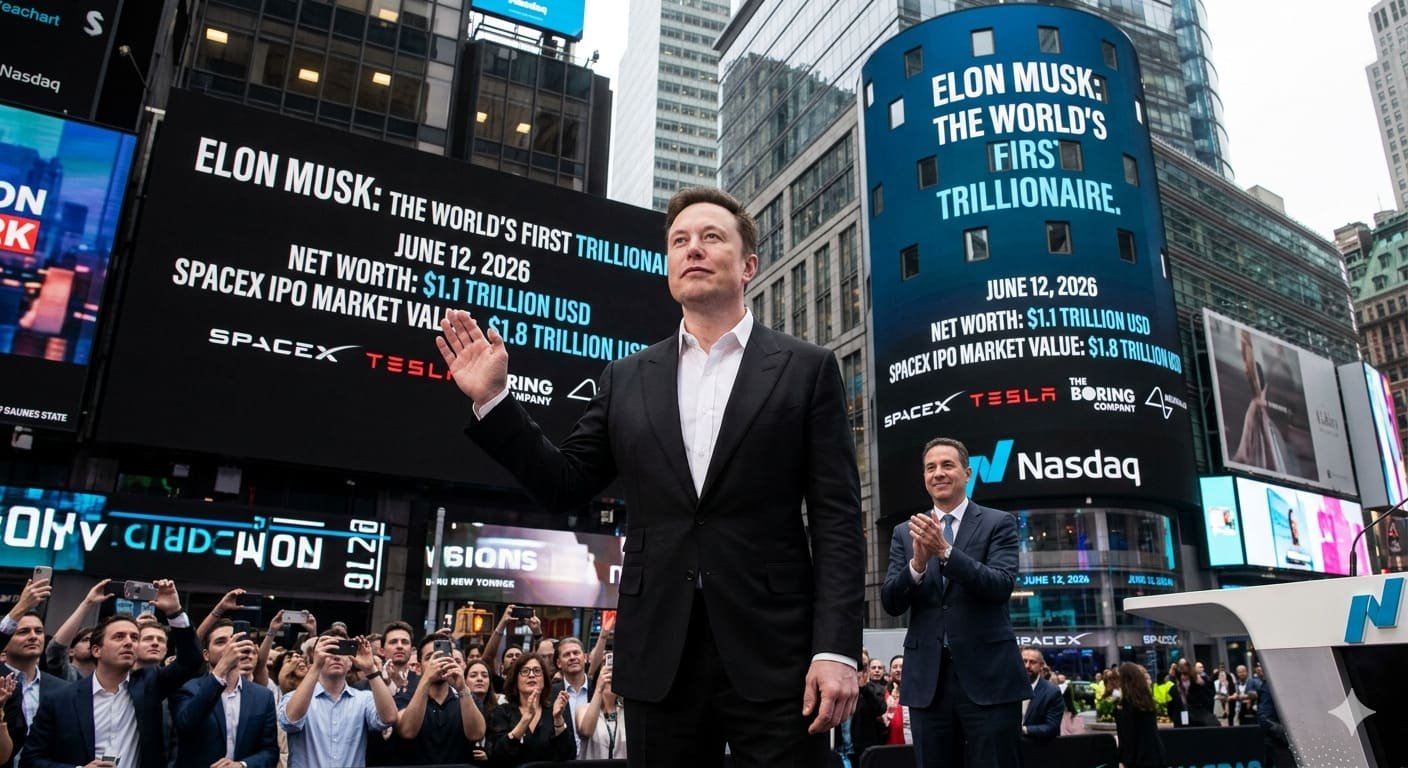
This week, something happened that has never happened in human history: one person's net worth crossed one trillion dollars.
The trigger was the stock market debut of SpaceX. The rocket and satellite company began trading on the Nasdaq under the ticker SPCX, opening at $150 a share after pricing its IPO at $135, making it the largest public offering ever, raising around $75 billion. Musk's stake in SpaceX is now worth more than $766 billion, and combined with his roughly $280 billion Tesla stake, his total net worth landed at about $1.05 trillion. Fox BusinessCNBC
So what does a trillion dollars actually look like?
Our brains aren't built to tell the difference between a billion and a trillion; both just register as "a lot." But the gap is enormous.
A million seconds is about 12 days. A billion seconds is about 32 years. A trillion seconds is roughly 32,000 years, back when humans were sharing the planet with Neanderthals.
Musk's net worth alone is larger than the entire economy of Taiwan, Ireland, or Sweden, and is worth more than the next five richest people on the planet combined. CNBC
But there's an important catch: this isn't cash sitting in a bank account. It's the paper value of his shares, what they'd theoretically be worth if sold all at once on the open market, which isn't really possible without crashing the price.
Why is SpaceX worth this much?
SpaceX brought in $18.67 billion in revenue last year, a fraction of what tech giants like Meta or Tesla make. So why is Wall Street valuing it near $1.8 trillion? CNBC
The bet isn't really on rockets. SpaceX controls the majority of active satellites in orbit, and is positioning that network as infrastructure for AI computing in space, data centers that don't depend on power grids or land-based internet. On top of that, investors are openly betting on the long-term vision Musk has been talking about for years: using this capital to fund a permanent settlement on Mars.
What it means for everyone else
Here's the part that touches ordinary people, even if they've never bought a SpaceX share. As SpaceX gets added to major stock indexes over the coming weeks, it will automatically flow into retirement funds and pension portfolios around the world, quietly tying everyday savers to the fortunes of the world's richest person.
It's a moment that says less about one man, and more about how concentrated wealth, infrastructure, and technology have become intertwined in 2026.
Comments ()
Sign in to join the conversation
Sign InNo comments yet. Be the first to share your thoughts!
Comments will be loaded here...