
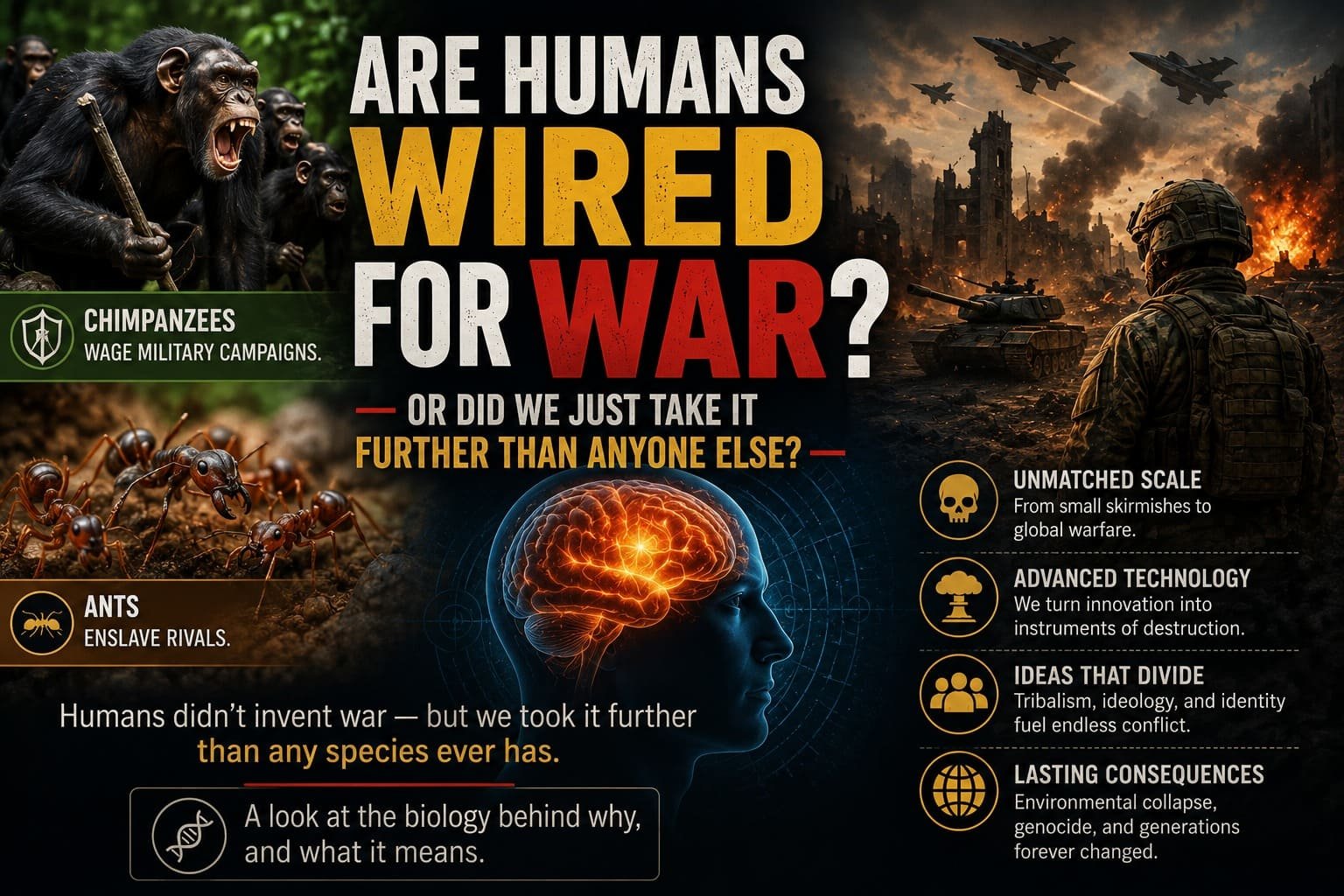
Are Humans Wired for War or Did We Just Take It Further Than Anyone Else?
Chimpanzees wage military campaigns. Ants enslave rivals. Humans didn't invent war, but we took it further than any species ever has. A look at the biology behind why, and what it means.
<p>There is a question that surfaces every time a new conflict breaks out, every time another war dominates the headlines, every time the death toll climbs past a number the mind can no longer process: is this just what we are? Is violence not a failure of human civilisation, but a feature of it?</p><p>
The science has an answer. It is more complicated, and more unsettling than most people expect.</p><p>
<b>We did not invent this</b><b></b></p><p>
The first thing the biology establishes is that humans did not invent war. We inherited it.</p><p>
Organised, lethal, group-against-group violence between members of the same species exists in nature. It is rare, but it is real and the two species that practise it most recognisably are ones that have been studied extensively.</p><p>
Ants have been waging war for millions of years. Argentine ant supercolonies fight bloody border conflicts involving millions of casualties to control territory and resources. Some species breed specialised soldier castes, ants with oversized jaws designed for a single purpose. Others conduct raids on rival colonies, kill the adults, and carry the young back to be raised as forced labour. This is not behaviour that requires much imagination to recognise.</p><p>
Then there are chimpanzees. Between 1974 and 1978, primatologist Jane Goodall documented something that changed how scientists understood animal behaviour permanently. A chimpanzee community in Gombe, Tanzania split into two rival groups. Over four years, one group hunted the other with methodical, organised precision, silent patrols, coordinated ambushes, attacks on isolated targets, until every male in the rival group was dead and the group itself no longer existed.</p><p>
It looked, in almost every meaningful way, like a military campaign.</p><p>
Organised violence also appears in wolves, lions, banded mongooses, and naked mole rats, though with less tactical sophistication. The point stands: the instinct for group violence against rivals is not a human invention. It is woven into the biology of highly social, territorial species. We are one of those species.</p><p>
<b>So why does human war feel so different?</b><b></b></p><p><i><b>
Because it is. </b></i>Every instance of animal warfare is driven by something immediate and concrete. Territory. Food.</p><p>
The survival of offspring. There is a natural ceiling on it, when the resource is secured, or the cost becomes too high, the conflict ends. The animal body and brain were not built to sustain violence beyond what survival requires.</p><p><b><i>
Human warfare broke through that ceiling a long time ago.</i></b></p><p>
We are the only species that fights over ideas. Not land, not food, not a specific water source but abstract concepts that cannot be touched or measured. Nationhood. Religious belief. Economic systems. Historical grievances carried across generations. Ideological identity. Because these things have no physical limits, conflicts over them can scale without end. You can divide a piece of land and negotiate a border. It is far harder to negotiate with someone whose entire sense of who they are is built around a belief system that yours threatens.</p><p>
This is what separates a chimpanzee border skirmish from the First World War. One is about a patch of forest. The other is about competing visions of the world, abstractions so powerful that millions of people willingly died for them.</p><p>
<b>The moment everything changed</b><b></b></p><p>
There is a specific turning point in human history worth identifying, not a date, but a development.</p><p>
For most of our existence, killing required physical proximity. You had to be close enough to see the person, hear them, feel the resistance of their body. That proximity activated something important: the empathetic responses that evolution built into us to slow violence down. Even in our most aggressive moments, our biology pushed back.</p><p>
Then we invented distance.</p><p>
Arrows first. Then artillery. Then aircraft. Then missiles. Then the ability to end thousands of lives by pressing a button from the other side of the world, without seeing a face, hearing a voice, or triggering a single empathetic response. The gap between the decision to kill and the physical act of killing grew so wide that the biological brakes, the ones that were always supposed to engage, stopped reaching.</p><p>
At the end of that progression sits the nuclear weapon. A technology that allows a conflict rooted in ancient tribal instinct to produce consequences that no tribal conflict was ever meant to produce. A disagreement between two groups of people that could, if taken to its conclusion, end the habitability of the planet.</p><p>
The instinct is old. The weapon is new. That mismatch is the most dangerous thing our species has ever created.</p><p>
<b>The switch that turns ordinary people into soldiers</b><b></b></p><p>
One more mechanism is worth understanding, because it explains something that has always troubled people about human history: how ordinary, decent individuals end up participating in mass violence.</p><p>
For most of our evolutionary history, survival depended entirely on tight cooperation within a small group. To build that cooperation, human psychology evolved a fast, powerful mechanism, the ability to distinguish sharply between the people who are "us" and the people who are "them." In normal times this shows up as team loyalty, political identity, cultural pride. Under enough pressure, it activates at full intensity.</p><p>
And when it does, something specific happens: the "them" stops being perceived as fully human.</p><p>
That cognitive shift, dehumanisation, is something no other animal is capable of in the way humans are. A chimpanzee attacks a rival because it perceives a direct physical threat. A human being can be conditioned, through language, imagery, and ideology, to commit violence against someone they have never met, who poses no immediate threat to them personally, on the basis of an abstract idea about what that person represents.</p><p>
Once that switch is flipped, the normal brakes stop working. History is full of examples of what happens next.</p><p>
<b>So which is it, wired for war, or did we just go too far?</b><b></b></p><p>
Both, is the honest answer.</p><p>
The instinct for group conflict is real and biological. It predates us. It is shared with species that have been on earth far longer than we have. Pretending it does not exist, that war is simply a product of bad leadership or correctable social conditions, does not hold up against the evidence.</p><p>
But the scale, the abstraction, the technological amplification, the capacity to fight over ideas rather than resources, and the ability to kill without proximity or empathy, those are ours alone. We did not just inherit the instinct. We took it somewhere no other species has ever gone.</p><p>
The question that follows from that is the one every generation has had to wrestle with and none has fully answered: knowing what we are capable of, and knowing why, what do we choose to do about it?</p><p>
That is not a biological question. That is a human one.</p>
Date
Featured
Verified
Community Engagement
Community
⚔️
📝
👁
🎯
📊
✏️
Comments ()
Sign in to join the conversation
Sign InNo comments yet. Be the first to share your thoughts!
Comments will be loaded here...