
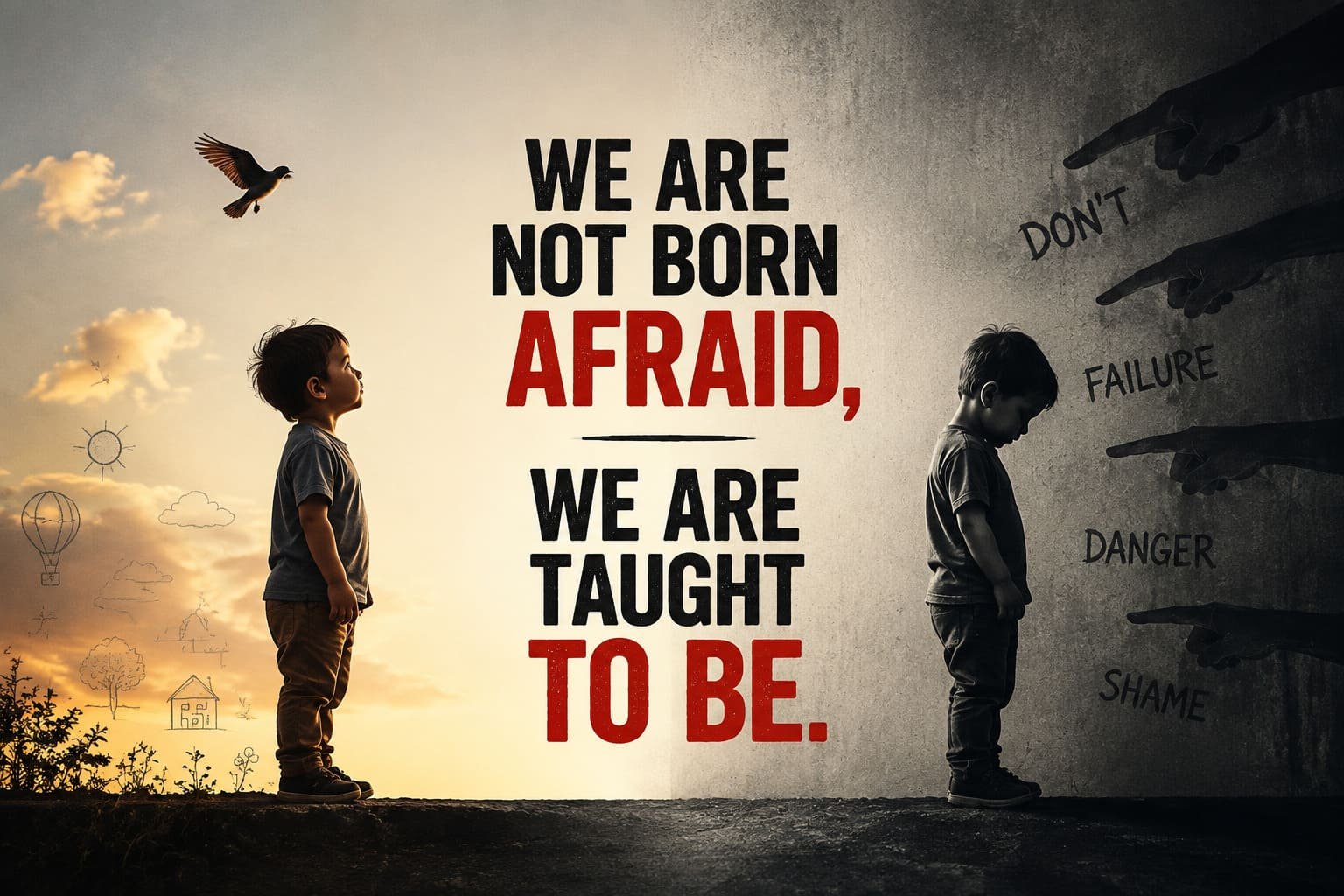
Somewhere in your life, someone decided what was dangerous. And you believed them. You had no reason not to.
That is how fear works. Not as a biological alarm built into your DNA, but as a lesson absorbed so early, and so completely, that it eventually felt like instinct. The truth, according to decades of developmental psychology, is more surprising than most people realise: human beings are born almost entirely without fear. We arrive in the world open, curious, and unbothered by almost everything in it.
Then the adults around us get to work.
There is a well-documented observation in infant research that is worth sitting with. Place a harmless snake in a controlled space with a six-month-old baby. Leave them together, without adult interference, and watch what happens.
The baby does not scream. Does not recoil. Does not show any sign of distress. Instead, the infant reaches forward; curious, unhurried, genuinely interested in this moving, patterned thing. To a baby, a snake registers the same way a colourful ribbon does, or a rolling ball. It is simply new information. Interesting information. The kind worth exploring with an open hand.
Now bring an adult into the room.
The moment the adult gasps, or tenses, or reaches forward in alarm, everything changes. Not because the snake has changed. Because the baby's brain, which is exquisitely tuned to read the faces and bodies of the people around it, has just received a very clear message. The widened eyes, the elevated voice, the sudden movement, all of it translates instantly. That thing is dangerous. Remember this.
The baby was not afraid of the snake. The baby became afraid of the adult's reaction to it. And from that moment, the association is made, stored, and carried forward into a life.
Psychological research is fairly clear on what we actually arrive in the world fearing. The list is short. A sudden loss of physical support, the feeling of falling, triggers a fear response in newborns. So does a sudden loud sound. That is largely it. Two reflexes, both tied directly to immediate physical survival, both present from birth.
Everything else; spiders, dark rooms, deep water, heights, enclosed spaces is learned. Acquired through watching the reactions of the people around us, through warnings issued by protective adults, through a childhood spent absorbing the anxieties of the world we were born into. We inherit the fears of our parents the way we inherit their expressions or their gestures.
Naturally. Invisibly. Without ever being asked whether we agree.
And then there are the fears that come later, the more abstract, more personal ones. The fear of failure. Of rejection. Of being seen as ordinary, or incompetent, or not enough. These are not reflexes. They are stories, built up over years of experience and cultural conditioning, until they feel as solid and inevitable as bone.
None of them started that way.
There is something quietly significant in all of this. If most of what we fear was taught to us, then it can, at least in principle, be examined. Questioned. Mapped back to its origin. You can ask, about almost any fear you carry, where it actually came from. Who first communicated to you that this particular thing was something to avoid. Whether the lesson was accurate. Whether it still applies.
That is not a small thing. Most people go through life treating their fears as fixed features of themselves, personality traits, or instincts, or evidence of some private inadequacy. The research suggests they are mostly just old lessons that were never updated.
The baby reaching for the snake was not being reckless. It was being honest about what it actually knew, before it had been told what to think. There is something in that worth remembering, the idea that somewhere beneath the accumulated warnings and inherited anxieties, the original version of you was considerably braver than the version that developed around it.
That version of you is still there. It never went anywhere.
It is simply waiting for you to question the story you were handed, and decide for yourself which parts of it are actually true.
Comments ()
Sign in to join the conversation
Sign InNo comments yet. Be the first to share your thoughts!
Comments will be loaded here...