
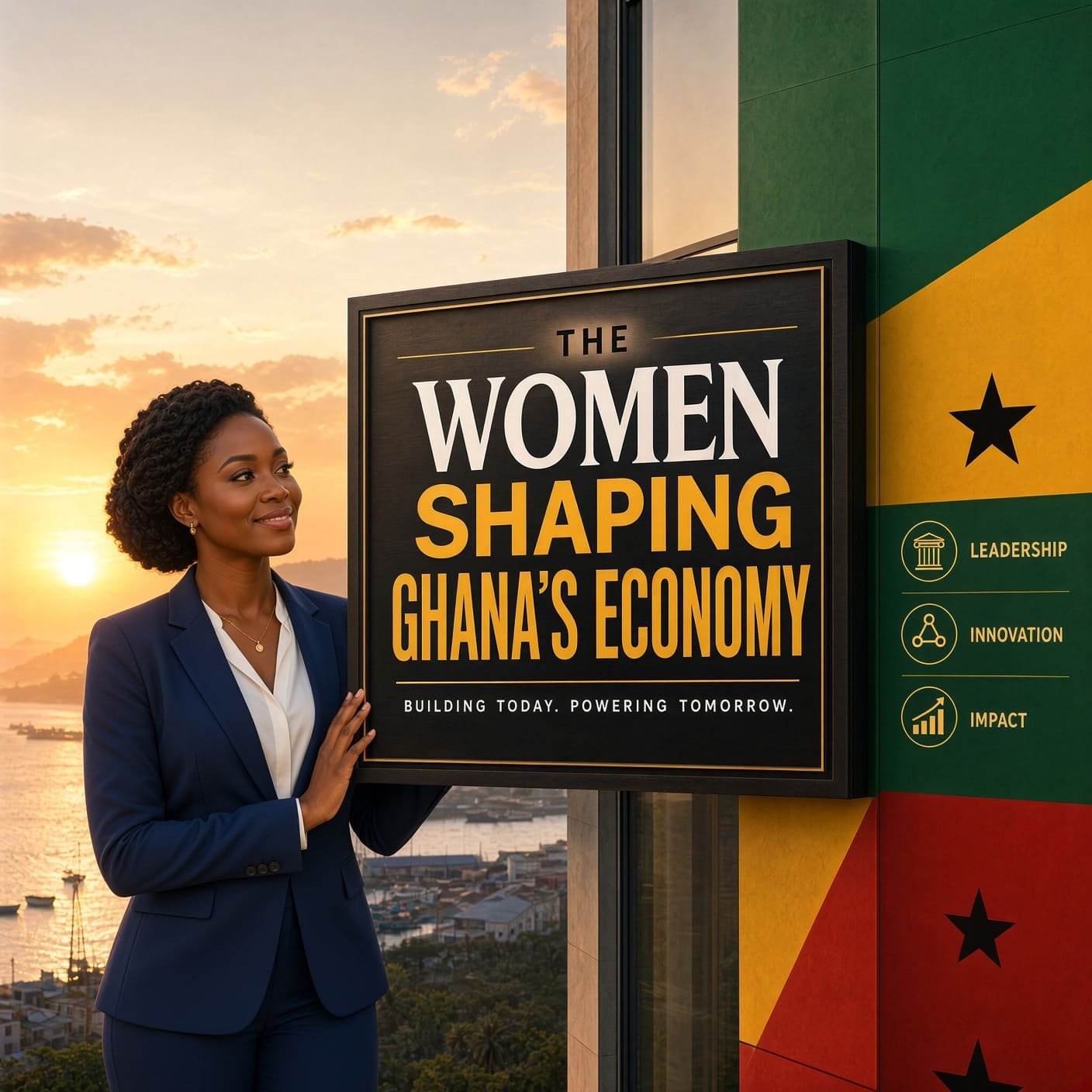
When we published our list of the 20 men who move Ghana's economy, one thing stood out. Every name was a man. That doesn't mean women aren't shaping the economy. It means their power often looks different.
Women make up about 51% of Ghana's population, as Trade Minister Elizabeth Ofosu-Adjare reminded a room of female CEOs in May 2026. Yet you rarely see them on "richest" lists. Many hold power through institutions, not personal fortunes: they run the regulators, the exchanges, the banks and the newsrooms.
So we used the same test as before. Not how much money they have, but how much they shape the way money moves in Ghana. Here are the women we found.
The women running the money.
1. Abena Amoah — Managing Director, Ghana Stock Exchange.
If you made money on Ghanaian shares this year, she was running the market. By the end of August 2026 the stock exchange had returned over 71% for the year in cedi terms, one of the best results in Africa.
She started as a stockbroker and became the exchange's first female executive director before taking the top job in 2022. In June 2026 she was named to chair a regional committee of the International Capital Market Association, giving Ghana a seat at the global table. She has also been asking Ghanaians abroad to bring their money home through the market.
2. Matilda Asante-Asiedu — Second Deputy Governor, Bank of Ghana.
She began as a journalist at Joy FM and TV3, moved into banking, and ran retail banking at Access Bank. In 2025 President Mahama appointed her Second Deputy Governor of the central bank.
In May 2026 the Governor sent her to represent the Bank of Ghana on the Ghana Gold Board. That puts her in the middle of the country's most watched economic policy: how Ghana buys and sells its gold.
3. Elizabeth Ofosu-Adjare — Minister for Trade, Agribusiness and Industry.
She is the policy voice on this list. She is pushing a Ghana Women's Development Bank, backed by GH¢401 million in the 2026 budget, to give women cheaper loans and easier collateral rules. She also points women in factories, farming and retail toward the new 24-Hour Economy law.
4. Pearl Nkrumah — Managing Director, Access Bank Ghana.
In October 2025 she became the first woman to run Access Bank Ghana in its 16 years in the country. She spent 14 years at Standard Chartered and a decade at Stanbic before that. She also chairs the Council of the Ghana Stock Exchange, which makes her one of the most visible women in Ghanaian finance.
The builders.
5. Patricia Poku-Diaby — Plot Enterprise.
Ghana grows some of the world's best cocoa, but for decades most of it left the country as raw beans. She decided to process it here. Her factory in Takoradi, opened in 2010, turns beans into cocoa liquor, butter, powder and, more recently, chocolate.
She is described as the only woman in Africa to set up a large cocoa processing business. She also runs a plant in Abidjan. In May 2026, she spoke at an Africa cocoa finance forum at the London Stock Exchange. Her story is the one Ghana keeps saying it wants: keep the value at home.
6. Kate Quartey-Papafio — Reroy Group.
She started Reroy in 1992 with her husband, after they couldn't find good cables to wire their own house. It began as a distributor and became a manufacturer, now with arms in power, metals, energy and infrastructure. Its plant is described as the largest cable factory in Ghana.
She is also called the first female cable manufacturer in the ECOWAS region. Today, she pitches Reroy as a supplier for the 24-hour economy push. In 2021, a court acquitted and discharged her in the Capital Bank case.
7. Theresa Oppong-Beeko — Manet Group.
Her first business, in fishing, failed and left her deep in debt. She went back to school and started again. In 1994, she founded Manet, now one of Ghana's biggest property developers, with a beach hotel at Ada, office towers, and its own construction arm. She built it in an industry that rarely made room for women.
Tech, media and the new economy.
8. Patricia Obo-Nai — CEO, Telecel Ghana.
An electrical engineer from KNUST, she joined Vodafone Ghana in 2011 to run its technology. In 2019, she became the first Ghanaian to lead the company. When Telecel Group bought Vodafone's 70% stake, she steered the switch to the Telecel brand.
Millions of Ghanaians make calls and send mobile money on her network every day. She also uses her platform to push more girls into science and tech.
9. Beatrice Agyemang — Group CEO, Media General.
She started as a reporter and news anchor at TV3, then rose to lead the whole company in 2018. Media General now runs TV3, 3FM, Onua TV, Onua FM, Akoma FM and Connect FM, among others. In 2024, it was named Media Organisation of the Year.
In our list of men, we said whoever owns the radio has a voice in politics. Here, a woman runs one of the biggest newsrooms in the country.
10. Farida Bedwei — Co-founder, Logiciel.
She was diagnosed with cerebral palsy as a baby and was home-schooled until age 12. She went on to co-found Logiciel and build gKudi, a cloud banking system used by about 130 microfinance firms in Ghana. That software helps small lenders give loans to people the big banks ignore. Her message is simple: a disability is not the end of a career.
What this list tells us.
Women hold the institutions, men hold the fortunes. Put this list next to the men's and the difference is clear. The men mostly own their companies. Most of the women here run institutions they don't own: the stock exchange, the central bank, a telecom, a media group, a bank. That is real power, but it is power on a contract, not on a share register.
The women who own, build. The three founders here, Poku-Diaby, Quartey-Papafio and Oppong-Beeko, all went into hard, heavy industries: cocoa processing, cable making and construction. None of them relied on government contracts the way several of the men did.
The doors are opening, slowly. Access Bank Ghana waited 16 years for its first female MD. The stock exchange's first female executive director now runs it. A 2026 study of 100 big Ghanaian institutions found the number of women chairing boards had nearly doubled since 2023, from 10 to 19. Progress, but 19 out of 100 is still a long way from half.
Money is the missing piece. The Trade Minister says many women still struggle to get loans and own business assets. The planned Women's Development Bank is the government's answer. Whether it works will decide if the next version of this list has more founders and fewer managers.
Ten names is not the full story. Thousands of market women, traders, and small business owners carry Ghana's economy every day, and none of them make headlines. This list is just the part you can see.
Sources.
- Women are key to Ghana's economic future – Trade Minister (Adom Online)
- GSE boss Abena Amoah lands global capital markets role (Citi Newsroom)
- GSE urges diaspora to invest (News Ghana)
- GSE appoints Abena Amoah as Deputy MD (GSE)
- Mahama appoints Matilda Asante-Asiedu (Rainbow Radio)
- Asante-Asiedu named to GoldBod board (MyJoyOnline)
- Access Bank Ghana's first female boss (Business Front)
- Patricia Poku-Diaby interview (RSIF-PASET)
- Kufuor to address ACFIF 2026 (Citi Newsroom)
- Kate Quartey-Papafio honoured (ModernGhana)
- Reroy ready for 24-hour economy (B&FT)
- Court acquits Reroy CEO (Citi Newsroom)
- How Theresa Oppong-Beeko built Manet (Billionaires.Africa)
- Telecel takes over from Vodafone (TechAfrica News)
- Beatrice Agyemang profile (IAA Africa Rising)
- Media General wins 2024 awards (3News)
- Farida Bedwei on gKudi (TechCabal)
- 2026 Top 100 Women Board Directors (BusinessGhana)
Comments ()
Sign in to join the conversation
Sign InNo comments yet. Be the first to share your thoughts!
Comments will be loaded here...