
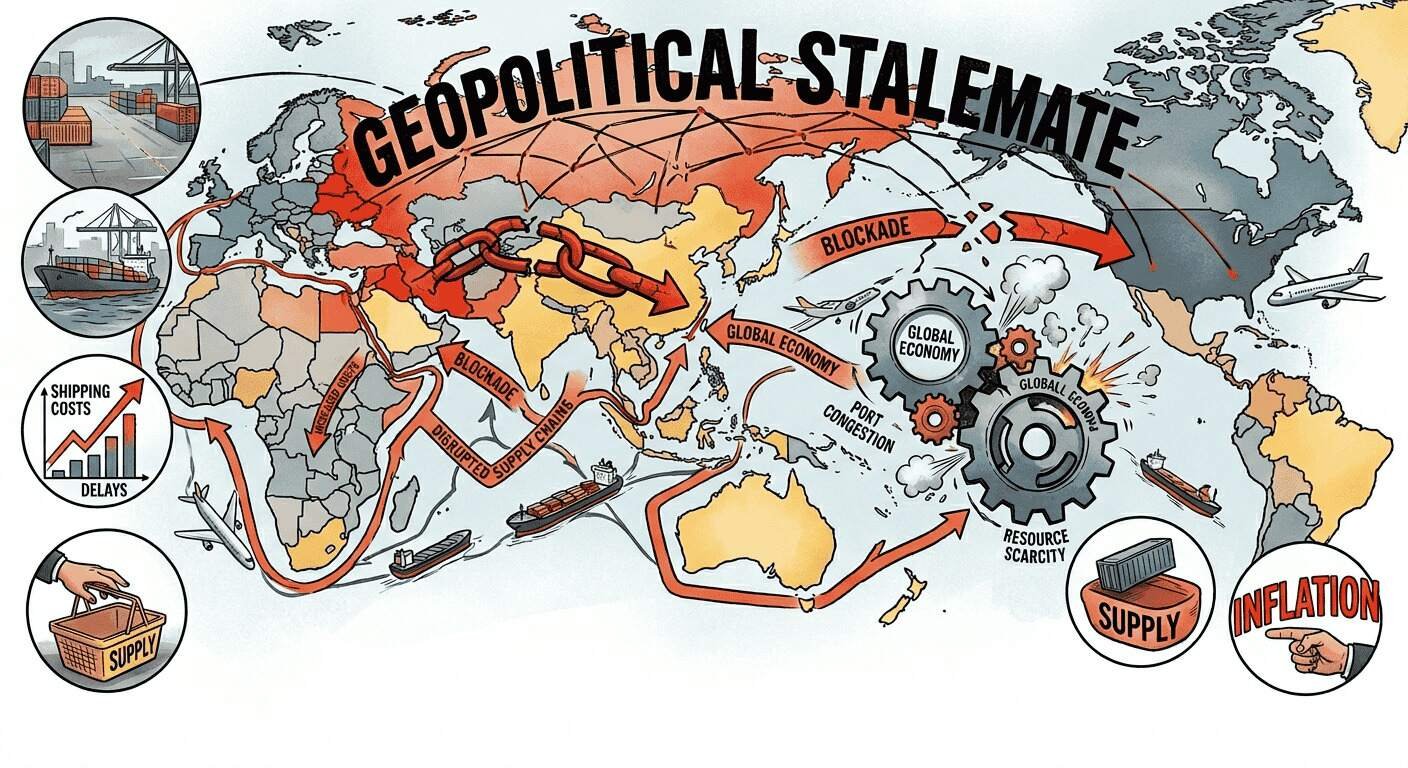
When historical conflicts persist past a certain threshold, they transition from breaking news into structural realities. In mid-2026, the international community finds itself navigating a deeply fragmented global security apparatus - defined not by sudden new wars, but by the slow institutionalization of existing ones.
+14 days added to Asia-Europe shipping via Cape route
2+ years of sustained Red Sea routing diversions
80 years since the UN was founded – now at a crossroads
The maritime tax: normalizing the Red Sea bypass
What began as sporadic, high-risk threats to shipping lanes in the Red Sea and Gulf of Aden has hardened into a permanent logistical calculation. For over two years, major commercial fleets have systematically rerouted away from the Suez Canal, opting instead for the considerably longer journey around Africa's Cape of Good Hope.
Shipping route comparison: Asia to Europe
- Asia / Indian Ocean→ Red Sea / Suez→ Europe [High risk, Avoided]
Asia / Indian Ocean→ Cape of Good Hope→ Europe [+10–14 days · New normal]
This structural shift is no longer treated by corporate boards as an emergency disruption — it is the new baseline. Shipping companies have fully absorbed the extended transit costs into annual freight contracts. The bypass functions as an indirect inflation mechanism, continuously pressuring global pricing on manufactured goods, agricultural inputs, and retail products. Maritime security is no longer an abstract concern for naval strategists; it is a direct line item on corporate balance sheets."
"Maritime security is no longer an abstract concern for naval strategists. It is a direct line item on corporate balance sheets."
Eastern Europe: the institutionalization of attrition
In Eastern Europe, the conflict in Ukraine has entered a prolonged, deeply calculated phase. The international focus has largely shifted from anticipating a decisive territorial breakthrough to managing a complex, long-term political and industrial equilibrium.
For Western alliances, defense policy has pivoted entirely toward structural sustainability. Legislative support packages out of Washington and Brussels are no longer emergency measures; they are the foundations of permanent domestic defense manufacturing lines designed for multi-year supply continuity.
Concurrently, Europe's economic divorce from legacy Eastern energy dependencies has entered its final, irreversible stages. The infrastructure built to replace those supplies has solidified, locking in higher structural energy costs for European heavy industry while permanently reorienting continental alliances.
Institutional strain: UN80 and the rise of mini-lateralism
This decentralized friction has pushed the post-World War II multilateral architecture to a critical inflection point. As the United Nations approaches its 80th anniversary, the systemic limitations of the Security Council have become impossible to ignore. The persistent use of the veto by competing superpowers has largely gridlocked central enforcement mechanisms, leaving the institution to focus primarily on humanitarian containment rather than conflict resolution.
In response, global diplomacy has pivoted toward mini-lateralism; smaller, highly focused tactical coalitions designed to protect specific economic or geographic interests. The age of universal institutions brokering universal peace may, for now, be suspended.
#GlobalTrade #RedSea #Ukraine #SupplyChains #UnitedNations #Geopolitics #Shipping #Hormuz #Iran
Comments ()
Sign in to join the conversation
Sign InNo comments yet. Be the first to share your thoughts!
Comments will be loaded here...