
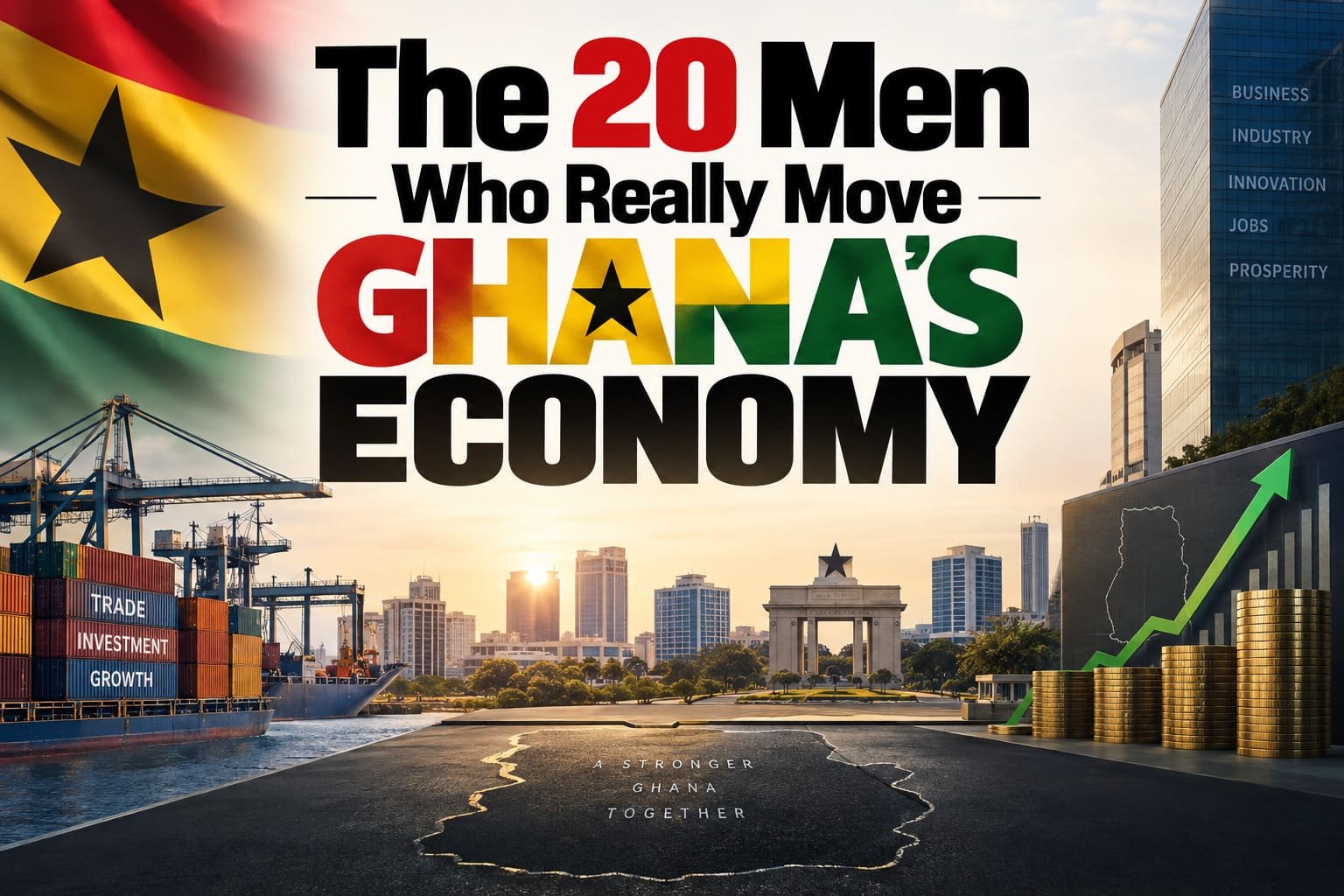
Search "richest men in Ghana" and you will find dozens of lists. Most of them disagree with each other. One even named the Governor of the Bank of Ghana as the country's richest CEO.
The truth is simple. Most big Ghanaian fortunes sit inside private companies that don't publish their accounts. Nobody outside those boardrooms really knows the numbers.
So we asked a better question. Not "who has the most money?" but "who has the most pull?" We looked at four things: how big their businesses are and how many people they employ, whether they control key sectors like mining, energy, banking or media, how close they are to government, and how much they shape public opinion.
Here is what we found.
The big five.
1. Ibrahim Mahama — Engineers & Planners, Dzata Cement.
No businessman had a bigger 2026. In April, the government handed his company, Engineers & Planners (E&P), the Damang gold mine after refusing to renew Gold Fields' lease. E&P showed it could raise $505 million, just above the $500 million the state demanded.
He started E&P in 1997, renting out heavy equipment. Today, he also runs Dzata Cement, a large poultry farm at Asutsuare, and a truck dealership. He is also the President's younger brother. Supporters say he earned every cedi. Critics say the family name opens doors. Both conversations will follow him to Damang.
2. Joseph Siaw Agyepong — Jospong Group.
If you have seen a Zoomlion truck, you know his work. Jospong started with waste management and grew into construction, finance, logistics, and more. He says the group now operates in about 25 African countries.
His wealth leans heavily on government deals, and that is also his weak spot. In 2025, the Presidency said Zoomlion's youth employment contract would not be renewed, and future sanitation deals would go to open tender. Zoomlion still holds other contracts with the assemblies.
3. Osei Kwame Despite — Despite Group.
He started out selling cassettes, padlocks, and baby bottles in Dunkwa-Offinso. In 1999, he launched Peace FM, Ghana's first non-English radio station, and changed local radio for good.
Today, his group owns four radio stations, UTV, Neat Foods, and a stake in Best Point Savings and Loans. His son, Kennedy Osei, already runs the group day to day. That tells you he is thinking about what comes next.
4. Ernest Ofori Sarpong — Special Group.
Despite's closest friend and business partner for 40 years. He is a chartered accountant behind one of Ghana's biggest property portfolios and Special Ice, a major drinks maker. He co-owns UTV and U2 iodated salt with Despite.
When he turned 60 in May 2026, both Kufuor and Bawumia showed up. He also gave PRESEC a 600-bed dormitory. In August, he became the first Chancellor of UniMAC.
5. Daniel McKorley — McDan Group.
He dropped out of school, came back, and built McDan into a group covering shipping, aviation, construction, mining, salt, farming, and real estate. In 2025, the Entrepreneurs Foundation of Ghana named him the "Most Influential Entrepreneur of All Time."
He also wears a chief's title in Tamale. Few businessmen move as easily between the Ga, the North, and the boardroom.
The institution builders.
6. Alex Apau Dadey — KGL Group.
KGL changed how Ghana's lottery and gaming business runs, mostly through digital platforms built with the state. In April 2026, the group paid GHS 153 million in corporate tax and publicly thanked President Mahama for backing local firms. KGL is also bringing a CNBC Africa office to Ghana.
7. Togbe Afede XIV — Strategic Initiatives.
A king who is also a banker. Born James Akpo, he built a brokerage and an investment firm, and co-owns Sunon Asogli Power with Chinese partners. He also founded Africa World Airlines and chairs Hearts of Oak. In 2026, he led Ghana's team to a global trade forum in Philadelphia.
8. Sir Sam Jonah — Jonah Capital.
The elder of Ghanaian business. He ran Ashanti Goldfields, later AngloGold Ashanti, and now chairs Jonah Capital. Young people still queue to hear him speak, and he has pushed openly for limits on the power of the presidency.
9. Edward Effah — Fidelity Bank.
He started Fidelity in 1998 as an advisory firm and turned it into Ghana's fifth-largest bank, with over $2 billion in assets. About 2.2 million people bank there today. He also chairs Unilever Ghana.
10. Kwasi Twum — Multimedia Group.
In 1995, he launched Joy FM with 12 staff. It became Multimedia, the home of Joy, Adom, Hitz, Asempa and JoyNews. If Despite speaks to the market woman, Twum speaks to the office worker and the policy maker.
Where business meets politics.
11. Kennedy Agyapong.
Real estate, farms, a shopping centre, and his own radio and TV stations, including Oman FM and Net 2. He tried twice to lead the NPP. In January 2026 he came second again, with about 24% to Bawumia's 56%. He lost the vote, but his media and his grassroots fans keep him loud.
12. Dr Kwabena Duffuor.
Former Bank of Ghana Governor, former Finance Minister and founder of the collapsed uniBank. The state charged him over the bank's fall, then dropped the case after recovering about 60% of the alleged losses. He remains a big name inside the NDC.
13. Richard Nii Armah Quaye — RNAQ Holdings.
One of the youngest names on this list, born in Jamestown in 1984. He built Quick Credit, later Bills Micro Credit, and Quick Angels, which backs start-ups. He has now stepped back from both to run a new holding company, RNAQ Holdings.
14. Nana Kwame Bediako "Cheddar" — Kwarleyz Group.
A property developer with a flair for drama. He revealed himself as the man behind the New Force movement and announced a 2024 presidential bid. He shows how new money now tries to turn fame into political weight.
Quiet influence.
These men rarely top rich lists, but they shape how business is done.
- 15. Patrick Awuah (Ashesi University): He left Microsoft to build a university that trains ethical leaders. Many young executives now carry the Ashesi mindset.
- 16. Ishmael Yamson: A former Unilever Ghana boss and the go-to voice on how companies should be run.
- 17. Herman Chinery-Hesse (SOFTtribe): Proof, decades early, that Ghanaians could build their own software.
- 18. Roland Agambire (AGAMS Group): A big developer with deep roots in the North, though his star shone brightest under past governments.
- 19. Ernesto Taricone (Tropical Cable & Conductor): He stands for the old industrial families, often of Lebanese or Italian heritage, who hold serious wealth and avoid the spotlight.
- 20. Kofi Amoah (Citizen Kofi): An investor who helped build Accra's tech and events scene.
The man who fell off the list.
Ken Ofori-Atta co-founded Databank and was once among the most powerful financiers in the country. He then served as Finance Minister. Today he lives in the United States while Ghana asks for his extradition on more than 70 criminal charges, which he and five others face. His lawyers call it a political witch hunt, and he is seeking permanent residency there. His story is the clearest warning on this list: in Ghana, power can disappear fast.
What this list tells us about Ghana.
Who is in power matters more than market share. The biggest winners this year are close to the current government. Damang went to the President's brother. KGL thanked the President by name. Zoomlion, which thrived under several governments, lost its biggest youth contract. McKorley once said openly that he started bidding for state work because the climate under the NPP felt right. In Ghana, fortunes rise and fall with elections.
Ghanaians now want to own their mines. For years, foreign miners renewed their leases almost automatically. Damang broke that habit. Now a local firm must prove it can run a mine that was producing only about a third of what it once did. If E&P succeeds, expect more mines to change hands.
Whoever owns the radio has a voice in politics. Four of the top eleven own major radio or TV stations. In a country where people still talk politics on the morning radio, that is real power.
Giving is part of the game. Dormitories, hospital bills, Black Stars donations. Big public generosity builds goodwill, and that goodwill helps when the political wind changes.
The next generation is being chosen now. Despite's son runs his group. Quaye has handed over the day-to-day work. Fidelity is run by professional managers. The question for the next ten years is whether these businesses outlive their founders, or end with them.
One last thing. Every name here is a man, because that is what we set out to rank. A separate list of the women shaping Ghana's economy deserves its own story.
Sources.
- Ghana awards Damang lease to E&P (Reuters via Kitco)
- E&P officially takes over Damang (Rainbow Radio)
- Ghana picks local firm for Damang (Ecofin)
- UMaT honours Ibrahim Mahama (Citi Newsroom)
- Siaw Agyepong at FGBMFI (AllAfrica)
- Zoomlion-YEA contract won't be renewed (Citi Newsroom)
- Zoomlion contracts fact-check (DUBAWA)
- Despite named African Entrepreneur of the Year (Peace FM)
- UniMAC appoints Ofori Sarpong (MyJoyOnline)
- Ofori Sarpong profile (Harvard ADC)
- McKorley EFG award (GBC)
- KGL pays GHS153m tax (Citi Newsroom)
- Togbe Afede leads WTC delegation (Citi Newsroom)
- Sam Jonah (Wikipedia)
- Fidelity founder honoured (Ghanaian Times)
- Multimedia Group
- NPP primary results (ModernGhana)
- AG drops Duffuor charges (Starr FM)
- Quaye steps down; RNAQ Holdings (Citi Newsroom)
- Ofori-Atta seeks US residency (Citi Newsroom)
Comments ()
Sign in to join the conversation
Sign InNo comments yet. Be the first to share your thoughts!
Comments will be loaded here...