

Watching PRESEC-Legon lift their 9th National Science and Maths Quiz trophy this week, it was easy to look at those students on stage and assume they were simply born different, wired for numbers and formulas in a way the rest of us aren't. It's a natural reaction. But it's also exactly the kind of thinking worth questioning.
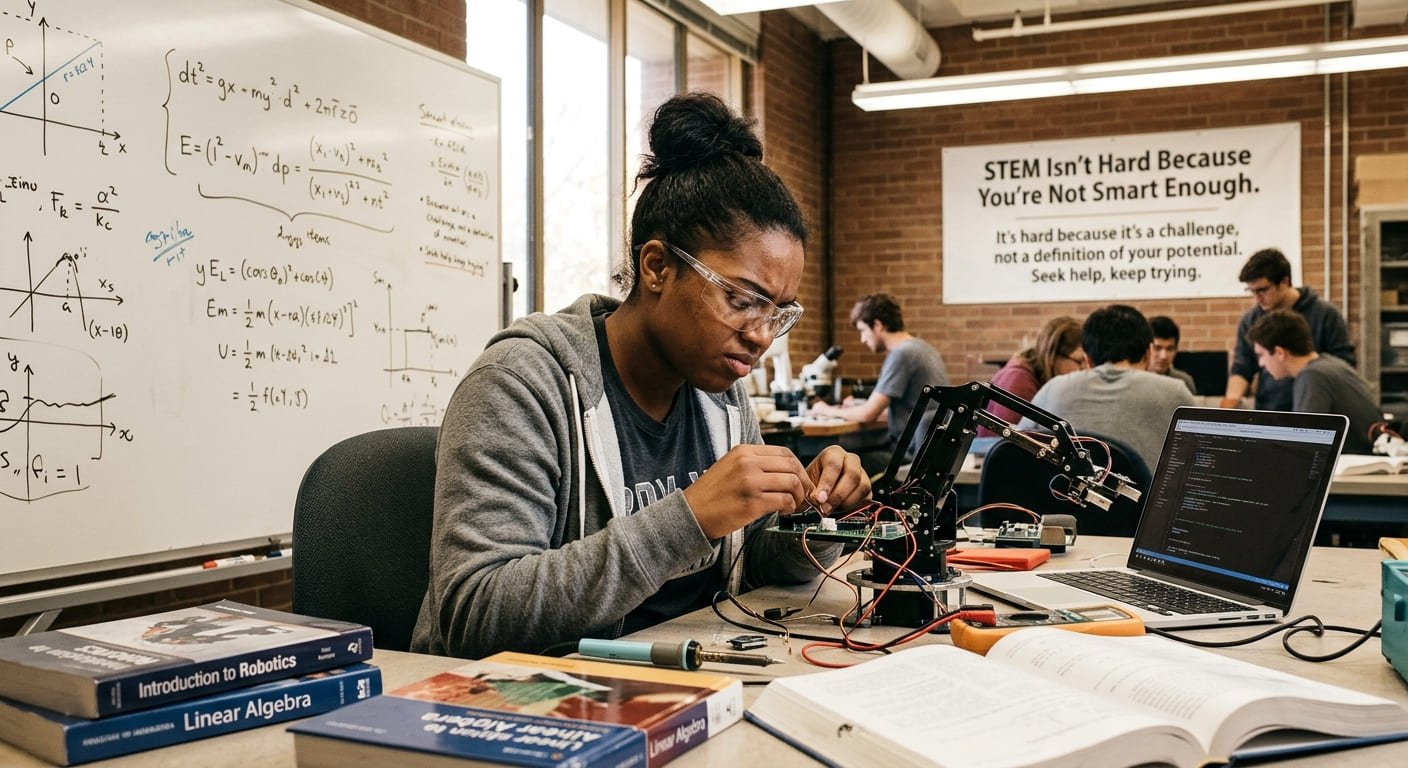
There's a persistent idea floating around that science, technology, engineering, and math are reserved for some small, gifted elite. It's an idea that gets repeated so often people just accept it as fact. But look closer and the truth is less about raw intellect and more about how these subjects are structured, taught, and experienced. STEM isn't hard because most people simply lack the brain for it. It's hard because of a handful of very specific, very fixable reasons.
Why STEM Feels Exceptionally Hard.
A big part of the difficulty comes down to how tightly these subjects build on themselves. Miss a foundational concept in algebra, or never quite lock down basic mechanics, and that small gap doesn't just sit there quietly. It compounds. By the time you're wrestling with calculus or fluid dynamics, that early confusion has multiplied into something much bigger, and it's rarely obvious that the real problem started several steps back.
There's also almost no room for ambiguity. In a lot of subjects, you can earn partial credit through good reasoning even if your final answer isn't quite right. STEM rarely works that way. You need the exact numerical answer, the correct logical sequence, or code that actually runs.
There's no partial credit for a program that almost compiles.
On top of that, a lot of STEM thinking asks you to hold entirely abstract systems in your head. Fields like computer science, quantum mechanics, or abstract algebra don't give you something tangible to picture. You're not working with objects you can hold or see. You're working with concepts that only exist as structures in your mind, and that kind of cognitive load is genuinely demanding in a way that has nothing to do with intelligence.
Why Only a Few Reach the Top.
If sheer intellect isn't the real filter, what is? Mostly, it comes down to environment and psychology, not innate genius.
A lot of it starts with how these subjects get taught in the first place. Standard curricula tend to lean heavily on memorization and speed testing rather than building genuine intuition. That approach quietly punishes students who learn conceptually instead of procedurally, and a lot of genuinely capable people drop out simply because the teaching style never matched how their mind actually works.
Then there's what you might call the brilliance myth, the cultural idea that succeeding in STEM requires some kind of natural gift you're either born with or not. The first time a student hits a genuinely hard problem, this myth tells them they must be missing the "STEM gene," and plenty of people walk away right there. In reality, persistence is almost always the real differentiator, not some innate talent that separates the chosen few from everyone else. It's worth remembering that the students competing at this year's NSMQ Grand Finale didn't get there by accident. Behind every buzzer-fast answer sits years of drilling, coaching, and simply refusing to quit after a wrong answer, not some rare gene the rest of us missed out on.
And finally, there's the simple matter of access. Getting good at technical fields early usually requires real labs, solid mentors, tight feedback loops, and structured environments to actually practice problem-solving in. When those resources aren't available, the pipeline narrows long before anyone's actual talent even gets a chance to show up.
The Real Differentiator.
None of this means STEM is easy. It genuinely isn't. But the gap between people who struggle and people who thrive has far less to do with natural aptitude than most people assume. Conceptual depth, deliberate practice, and a willingness to keep going after things stop making sense will get you further than raw talent ever could on its own.
That's really what this year's NSMQ champions represent, not proof that a select few are simply built for STEM, but proof of what happens when structured practice, good mentorship, and sheer persistence are given the room to work.
Comments ()
Sign in to join the conversation
Sign InNo comments yet. Be the first to share your thoughts!
Comments will be loaded here...