
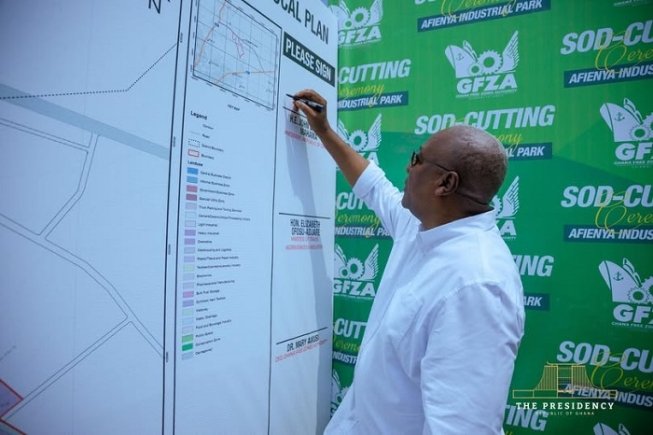
President John Dramani Mahama has urged investors setting up businesses at the Afienya Industrial Park to prioritise the employment of trained residents from host communities as construction of the 1,238-acre industrial enclave begins.
The President made the appeal on Thursday, October 15, during the sod-cutting ceremony for the project in the Greater Accra Region, stressing that local communities must benefit directly from the jobs and economic opportunities expected to emerge from the development.
He called for a dedicated training programme to equip residents of Afienya and surrounding communities with the technical and vocational skills required by companies that will establish operations at the park.
“I believe that if enterprises are located here, there should be a programme that trains the local people so that they can get some of the jobs created in this industrial park,” he said.
President Mahama explained that the project's success should not be measured solely by the number of factories established but also by the employment opportunities created for Ghanaians, particularly people living in communities hosting the development.
Industrial Park to Accommodate More Than 120 Enterprises
The Afienya Industrial Park is expected to accommodate more than 120 enterprises and provide investors with serviced plots, ready-to-use factory shells and essential infrastructure to support manufacturing and other business activities.
The facility is designed to attract investments in sectors including cocoa, cashew and oil palm processing, textiles and garments, pharmaceuticals, medical consumables, automotive components and assembly, and light engineering.
It is also expected to support businesses in logistics, data services, business process outsourcing, renewable energy and green manufacturing.
According to the government, the development is intended to expand Ghana's industrial capacity, increase domestic production and strengthen the country's position as a manufacturing and logistics hub for the West African sub-region.
The project comes as the Tema Export Processing Zone has reportedly exhausted its available space for prospective investors, creating the need for additional industrial infrastructure.
Government Targets Local Economic Benefits
Beyond direct factory employment, President Mahama called for farmers, transport operators, local suppliers and small businesses to be integrated into the industrial park's supply chains.
He said companies operating within the enclave should create opportunities for surrounding communities to supply raw materials, goods and services, enabling more residents to benefit from the investment.
The President also urged investors to establish their businesses in Ghana and use the country as a base for producing goods for markets across Africa and beyond.
He linked the project to the government's wider industrialisation agenda and the proposed $10 billion New Economy Programme, which is expected to support productive sectors and related infrastructure over four years.
Free Zones Authority Reports Initial Investor Interest
The Chief Executive Officer of the Ghana Free Zones Authority (GFZA), Dr Mary Awusi, said 14 companies had already been allocated land at the Afienya Industrial Park.
She emphasised the importance of ensuring that young people benefit from employment, skills development and technology transfer arising from investments at the facility.
The authority is expected to work with government agencies and private-sector partners to attract businesses capable of establishing viable operations at the park.
The Minister for Trade, Agribusiness and Industry, Elizabeth Ofosu-Adjare, also acknowledged the cooperation of traditional authorities in Ningo-Prampram and Shai-Osudoku, which helped make land available for the project.
Skills Development Seen as Key to Success
The President's call for local training highlights the need to prepare residents for the range of technical and professional roles expected to emerge as the park develops.
Although the project is expected to create employment opportunities, the extent to which residents benefit will depend partly on the skills required by incoming businesses and the effectiveness of training and recruitment arrangements.
The government has therefore been urged by the President to ensure that local people are equipped to compete for available positions while local suppliers and businesses are given opportunities to participate in the industrial value chain.
As construction begins, attention will turn to attracting investors, developing the necessary infrastructure and establishing the training programmes needed to connect surrounding communities to the jobs expected from the Afienya Industrial Park.
Photo courtesy: H. E. J. D. Mahama
Comments ()
Sign in to join the conversation
Sign InNo comments yet. Be the first to share your thoughts!
Comments will be loaded here...