
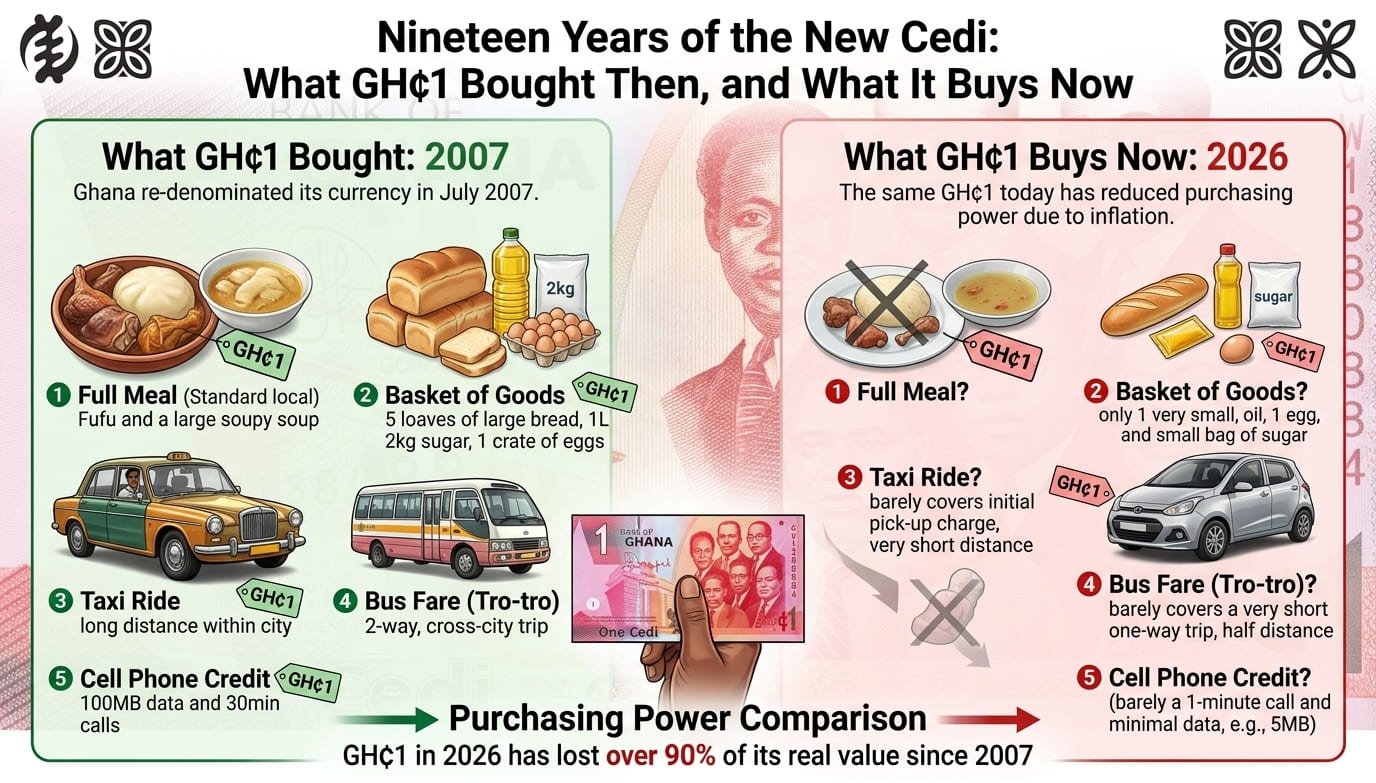
When Ghana knocked four zeros off the cedi on July 1, 2007, the idea was simple. Ten thousand old cedis became one Ghana Cedi. Big numbers would disappear, and so would the habit of carrying bundles of notes to the market. For a while it worked. A dollar cost about 92 pesewas, and the new GH¢1 felt like real money.
Nineteen years later, that dollar costs about GH¢11.60. To see what that change has meant for ordinary people, we tracked 10 everyday prices from the redenomination to today. The pattern is clear: the minimum wage has roughly kept pace with the dollar, but the cost of moving, cooking and keeping the lights on has run far ahead of both.
The yardstick: wages and the dollar
In 2007 the national daily minimum wage was GH¢1.90. Today it is GH¢21.77, about 11.5 times higher. Over the same period, the cedi went from about GH¢0.92 to roughly GH¢11.63 per dollar, a 12.6-fold fall in value.
On paper, the lowest-paid worker has roughly held their ground against the dollar. Ghanaians do not spend their wages on dollars, though. They spend them on transport, fuel, food and power, and that is where the story changes.
Transport: the biggest jump
In August 2007, the shortest trotro journey in a city cost 12 pesewas. Since September 26 this year, the starting intra-city fare has been GH¢5.50. That is about 46 times higher, the steepest rise on our list.
Put another way, a day’s minimum wage in 2007 paid for almost 16 of those short trotro rides. Today it pays for about four. For workers who commute daily, transport has quietly become one of the heaviest costs in the household budget.
Fuel: from one cedi to nearly nineteen
In late 2007, petrol sold at GH¢1.04 a litre and diesel at GH¢1.03. This month, petrol averages close to GH¢19 a litre and diesel about GH¢18.50. That is roughly 18 times higher.
A day’s minimum wage once bought nearly two litres of petrol. Now it buys about 1.2 litres. Filling a 40-litre tank cost about 22 days of minimum wage in 2007. It now costs more than 33 days’ pay.
Cooking gas tells the same story. LPG was GH¢1 per kilo in 2007. It is now between about GH¢15.70 and GH¢17 per kilo, depending on whose projection you use. Refilling a 14.5kg cylinder took less than eight days of minimum wage back then. Today it takes between 10 and 11 days.
Electricity: almost 30 times higher
Power has also risen far faster than wages. The tariff in force in 2007 charged households 7 pesewas per unit for the first 300 units. By April 2026, the comparable rate was GH¢1.97 per unit, and it rose a further 3.49% in July, to about GH¢2.04.
That is roughly a 29-fold increase. A household using 100 units a month paid about GH¢7 in 2007, under four days of minimum wage. Today the same usage costs about GH¢204 before service charges, which is more than nine days’ pay.
Food staples: rice and water
In 2008, a 50kg bag of Gino Thai perfumed rice sold for GH¢45, or about 90 pesewas a kilo. In April this year, a 5kg bag of imported rice averaged GH¢73.50 in Accra, about GH¢14.70 a kilo. That is roughly 16 times higher. A day’s minimum wage bought about two and a half kilos of rice in 2008. Today it buys about one and a half.
Sachet water is the one bright spot. It sold for 5 pesewas in late 2007. Since April this year, the recommended maximum retail price has been GH¢15 for a bag of 30, or 50 pesewas a sachet. That tenfold rise is actually slightly slower than wage growth, so a day’s pay buys a little more water today than it did in 2007.
Building: cement and the dream of a home
For a country where most people build their own homes slowly, cement matters. In early 2009, a bag cost about GH¢8 to GH¢9. Today it costs roughly GH¢110 to GH¢120, around 13 times higher. One bag now costs about five days of minimum wage.
There is some relief this year. Cement prices in May were 14.5% lower than a year earlier, helped by a stronger cedi in 2025. For families building block by block, that pause matters, but it comes after nearly two decades of steady increases.
What about rent and cars?
Two of the biggest costs for urban Ghanaians are missing from our list. We could not find a reliable 2007 benchmark for either, and we did not want to guess. What we do know is that a single room in Accra now typically rents for GH¢800 to GH¢1,800 a month. Even the bottom of that range is more than a full month of minimum-wage earnings.
The bigger picture
Three lessons stand out.
First, the cedi’s fall explains much of the story, but not all of it. Fuel, rice and cement rose somewhat more than the dollar, as you would expect for imported or import-dependent goods. Transport and electricity rose much more, which points to taxes, levies, utility cost recovery and operating costs on top of the exchange rate.
Second, the minimum wage has lagged behind most essentials. It tracked the dollar but not the cost of living. On almost every measure, a day’s pay buys less transport, fuel, power, rice and cooking gas than it did in 2007.
Third, the last 18 months have been unusual. Inflation dropped to its lowest levels in years, the cedi strengthened sharply in 2025, and some prices, such as cement, have actually fallen. Fuel and transport, however, rose again in September and October, and the cedi has weakened somewhat this year. Whether 2026 becomes a turning point or just a pause will depend on whether that stability holds.
The redenomination removed four zeros from the currency. Nineteen years on, the real question for Ghanaian households is not how many zeros are on the note, but how far a day’s work stretches. On that measure, there is still a long way to go.
Note: 2007 prices are taken from contemporaneous news reports and official announcements. The cement baseline is from early 2009 and the rice baseline from 2008, the earliest reliable figures we found. 2026 prices reflect the latest available official or market data. Electricity comparisons use the residential rate for usage up to 300 units and exclude service charges.
Sources:
- GhanaWeb: Budget 2007 highlights (redenomination)
- GhanaWeb: Exchange rate, July 9, 2007
- Trading Economics: Ghana minimum wage
- GhanaWeb: New daily minimum wage, 2008
- Playroll: Ghana minimum wage 2026
- MyJoyOnline: Fuel prices increased, Nov 2007
- GhanaWeb: Transport fares go up, Aug 2007
- GhanaWeb: Sachet water price hike, Dec 2007
- Graphic: Electricity tariffs from Nov 1 (2006)
- CemNet: Ghana cement prices rise (2009)
- MyJoyOnline: Primex rice price reduction (2008)
- MyJoyOnline: COMAC October 2026 fuel outlook
- GlobalPetrolPrices: Ghana
- Yen: COPEC October 2026 projections
- ModernGhana: New fares from Sept 26, 2026
- Citi Newsroom: Sachet water GH¢15 per bag
- GNA: PURC Q2 2026 tariffs
- Ghanaian Times: Tariffs up from July 1, 2026
- Ownkey: Building materials 2026
- CemNet: Falling cement prices, May 2026
- Citi Newsroom: Market Price Barometer, April 2026
- Ownkey: Renting in Accra 2026
Comments ()
Sign in to join the conversation
Sign InNo comments yet. Be the first to share your thoughts!
Comments will be loaded here...