

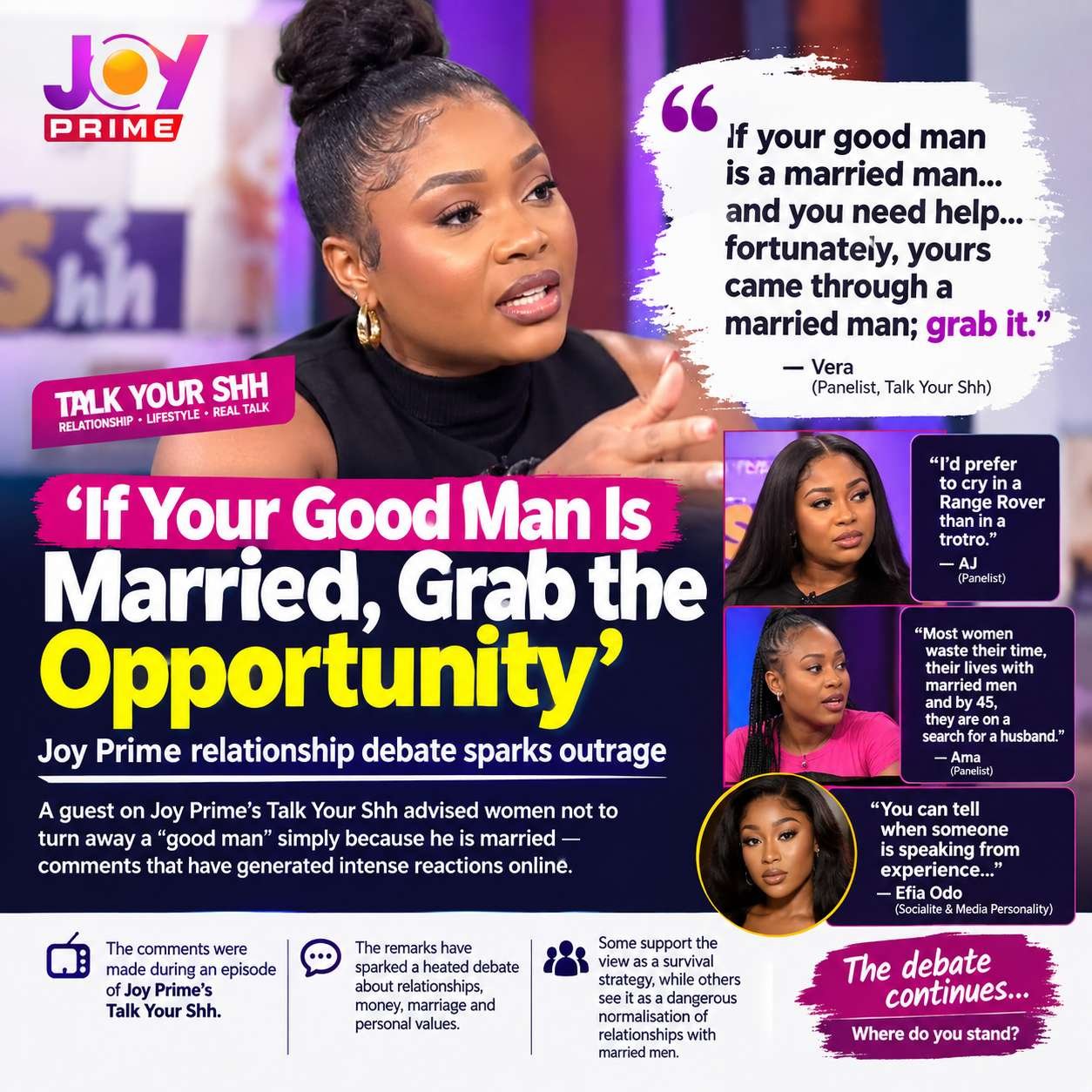
The comments, made during a discussion on “What is your definition of a good man, and do they exist?”, have generated strong reactions online, with critics accusing the panel of normalising relationships with married men and reducing romantic relationships to financial gain.
The controversy centres on comments by a panelist identified as Vera, who argued that some women may encounter only one genuinely supportive man in their lifetime and should therefore take advantage of the opportunity if that man happens to be married.
“If for you, your good man is a married man … and you need help … fortunately, yours came through a married man; grab it.”
Vera added that women in such circumstances should be strategic, using the relationship to improve their financial circumstances and build independence.
She suggested that a woman who does not intend to become a second wife could remain in the relationship temporarily, save and establish herself financially before eventually moving on.
Her comments have since been widely circulated across social media, turning what was initially a relationship discussion into a broader debate about morality, financial vulnerability, marriage and the kind of advice being presented to young Ghanaian audiences.
‘Opportunity comes but once’
Vera's argument was built around the idea that opportunities — including opportunities for financial support — may not come repeatedly.
She said some women are fortunate to meet several men who are willing to support them, while others may encounter only one person they consider a “good man.”
Her position was that if that person happens to be married, his marital status should not automatically prevent the woman from accepting the support.
She further advised women to “be wise” and concentrate on becoming financially independent rather than remaining permanently dependent on the man.
The comments, however, raised an immediate question among critics: Can a man be described as a “good man” if pursuing a relationship with another woman requires him to be unfaithful to his wife?
That question has become central to the online debate.
Efia Odo joins the backlash
Among those who have publicly criticised the comments is Ghanaian socialite and media personality Efia Odo.
Reacting to the viral discussion on X, Efia Odo questioned why women would encourage other women to enter relationships that could potentially harm another family.
“You can tell when someone is speaking from experience,” she wrote, adding that she could not understand why such advice would be offered to women.
Her reaction further propelled the discussion, with social media users debating whether the panelist's comments reflected practical realities faced by financially struggling women or represented a dangerous normalisation of relationships with married men.
The ‘Range Rover or trotro’ controversy
The married-man comments were not the only statements from the programme that attracted attention.
Another panelist, identified as AJ, sparked a separate debate after saying:
“I’d prefer to cry in a Range Rover than in a trotro.”
The comment was made in the context of defining what constitutes a “good man” and has been interpreted by critics as suggesting that material comfort can outweigh problems within a relationship.
Joy Prime itself published the clip featuring the statement, while the comment has subsequently circulated widely on social media.
The statement became particularly controversial because the discussion reportedly touched on relationships in which a woman may experience mistreatment but still receive expensive gifts or financial benefits.
Critics have questioned whether wealth and luxury should ever be used to compensate for disrespect, infidelity or physical abuse.
Not everyone on the panel agreed
Importantly, the programme was not presented as a unanimous endorsement of relationships with married men.
Another panelist, Ama, took a markedly different position.
She warned that women who become involved with married men could spend years waiting for a relationship that may never result in marriage.
In one of the clips published by Joy Prime, Ama argued that some women end up wasting years with married men and later find themselves praying for a husband.
That disagreement adds an important dimension to the controversy: the programme featured competing perspectives, rather than a single collective position from all the women on the panel.
Why the comments have struck such a nerve
The controversy touches on a much larger Ghanaian conversation about relationships and economic hardship.
For many young people, financial insecurity has become an important factor in dating and marriage decisions. Critics of the viral remarks argue that this reality should encourage conversations about financial independence rather than acceptance of potentially exploitative relationships.
Supporters of Vera's position, meanwhile, have argued that adults should be allowed to make their own relationship choices and that financial realities cannot simply be ignored when discussing modern relationships.
The debate therefore goes beyond the question of whether dating a married man is morally acceptable.
It raises a more uncomfortable question:
When financial hardship enters a relationship, where should a person draw the line between accepting help and compromising personal values?
Questions about media responsibility
The controversy has also placed attention on Joy Prime and its responsibility as a mainstream media platform.
“Talk Your Shh” is a relationship and lifestyle programme designed to facilitate candid conversations about issues affecting young people. The format deliberately encourages guests to express strong personal opinions on relationships, sexuality and social issues. Joy Prime's parent platform describes the show as a women-focused programme featuring unfiltered discussions on relationships and lifestyle.
That format can generate compelling television, but it also creates questions about the boundary between provocative entertainment and potentially harmful advice.
Critics have questioned whether controversial statements should be challenged more aggressively by programme hosts, particularly when discussions involve domestic abuse, infidelity or financial dependence.
The debate continues
The reaction to the episode demonstrates the power — and risk — of social-media-driven television.
A statement made during a relationship discussion has moved beyond the programme itself and become a national conversation about what women should expect from men, whether money can compensate for relationship problems, and whether marital status should be an absolute boundary.
For Vera, the argument appears to be about survival and self-improvement: if a financially struggling woman encounters someone willing to support her, she should use the opportunity to change her circumstances.
For critics, however, the danger lies in presenting that arrangement as an acceptable route to financial independence — particularly when another marriage and family may be affected.
And perhaps that is why the debate has resonated so strongly.
At its heart, the controversy is not simply about married men.
It is about money, morality, marriage, personal dignity and the increasingly complicated choices people make when love and financial survival collide.
For now, the viral comments continue to fuel conversation online, while the wider question remains unresolved: Is financial security worth compromising the boundaries of marriage — or should a genuinely “good man” be expected to respect those boundaries in the first place?
Comments ()
Sign in to join the conversation
Sign InNo comments yet. Be the first to share your thoughts!
Comments will be loaded here...