
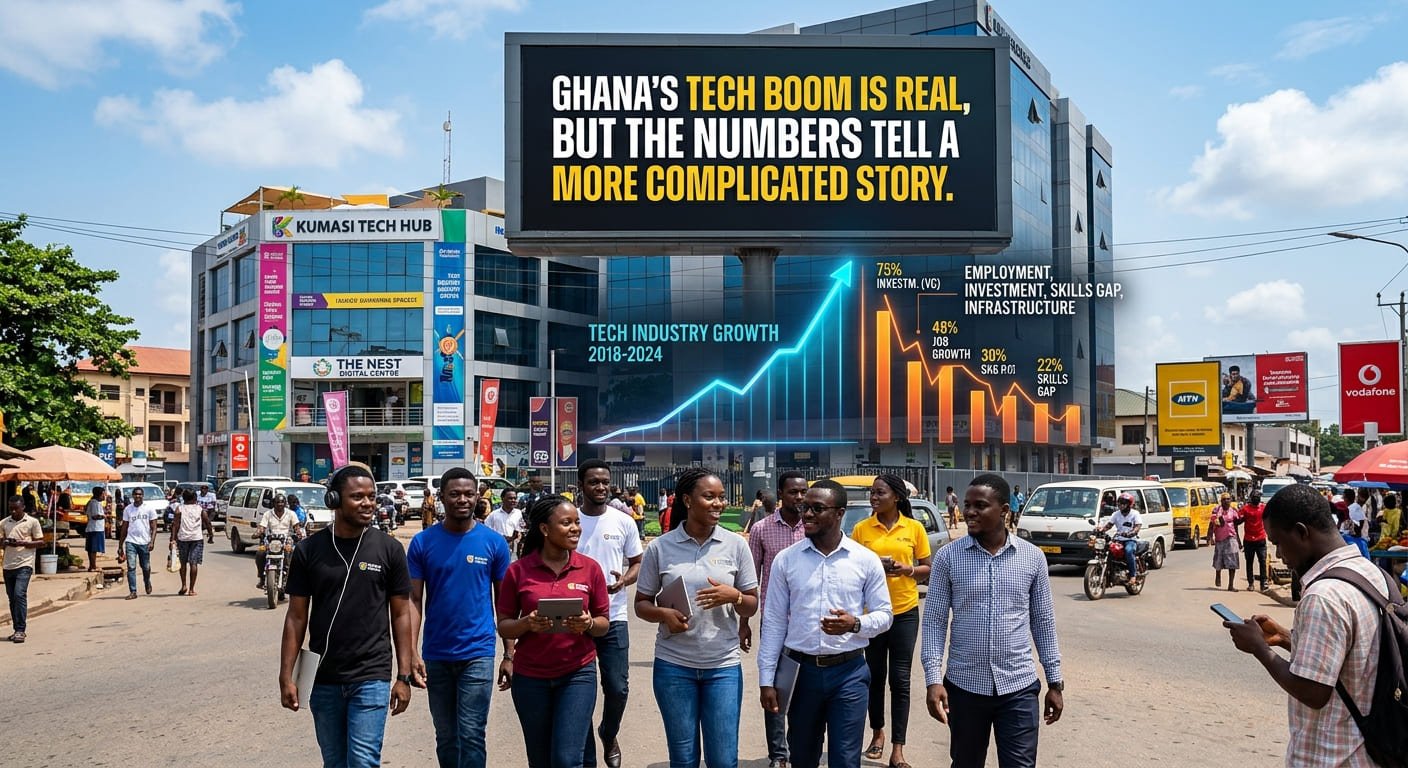
Ghana's technology sector is having a genuine moment, and the numbers back that up. According to Ghana Statistical Service data released in September 2026, the information and communication technology sub-sector grew 30.9 percent year on year in the second quarter of 2026, up from 21.3 percent a year earlier, and accounted for roughly 41.5 percent of the country's entire GDP growth that quarter. The quarter before that, ICT expanded 25.2 percent while the broader economy grew 6.4 percent. This isn't a one-off spike either. Government statistician Alhassan Iddrisu has pointed out that ICT has now posted double-digit growth in every quarter for the past three years. Add in Google's AI research lab in Accra and a steady stream of ambitious infrastructure announcements, and it's easy to see why people are calling Accra a gateway to West African tech.
But spend time with actual founders and engineers, and a very different picture starts to emerge, one where corporate and fintech success sits uncomfortably next to a much harder early-stage reality.
What People on the Ground Are Saying.
The optimists point to exactly the numbers above: strong mobile money penetration, a stable democracy, and a growing list of infrastructure commitments as proof that Ghana is positioned to lead the region.
Founders tell a rougher story. Equity funding has tightened considerably, local purchasing power remains limited, and early-stage capital is genuinely hard to come by, especially once you get past the first check.
Engineers, meanwhile, describe something closer to a talent drain in slow motion. Ghana is training genuinely strong software engineers, but a lot of that talent ends up working remotely for American or European companies to earn dollars or euros, leaving local early-stage startups struggling to compete on salary.
What Ghana Is Actually Doing Well.
The clearest success story is fintech infrastructure. Ghana's mobile money interoperability system remains one of the most functional in Sub-Saharan Africa, and the scale is genuinely impressive. There were roughly 74.1 million registered mobile money accounts as of February 2025, and Ghanaians moved an estimated GH¢3.6 trillion through mobile money between January and October of that year alone. That kind of payment rail has become the backbone for digital commerce, agent banking, and micro-lending across the country.
There's also real density in the early-stage ecosystem. Organizations like MEST, the Accra Digital Centre, and the Ghana Hubs Network have built a fairly structured incubator pipeline over the years, and the local pool of software developers, cloud engineers, and UI/UX designers is larger and more capable than it's ever been.
Where the Story Gets Harder.
This is where things get more complicated than the headline numbers suggest.
Too many Ghanaian tech products are still built for a domestic market of roughly 34 million people, and that market gets exhausted quickly. Startups that want real scale increasingly need to design for Francophone West Africa, Nigeria, and Kenya from day one, not as an afterthought once local growth stalls.
Capital remains the biggest structural gap. Ghana raised about $56 million in startup funding in 2025 according to the tracker The Big Deal Africa, placing it eighth among African markets, well behind Kenya's $984 million, Egypt's $614 million, South Africa's $600 million, and Nigeria's $343 million. Together, those four countries captured 82 percent of all funding raised across the continent that year. Most of what Ghana did raise came from foreign VC funds and development finance institutions rather than local sources. That's part of why the Ghana Venture Capital and Private Equity Association has been pushing to raise the share of pension fund assets allowed into local private equity and venture capital from 1 percent to 5 percent, a change that could unlock as much as $337 million in domestic capital by the end of 2026 if it goes through.
A lot of local innovation also still leans heavily on simpler consumer apps, delivery platforms, booking tools, and similar products competing in crowded, low-margin categories, rather than deeper technical work in areas like agriculture, energy, or supply chain infrastructure where the problems are harder but the payoff is bigger.
And then there's the regulatory side, which has been genuinely slow. The Ghana Innovation and Startup Bill was first drafted back in 2020, revived again under the current administration, and given a target of July 2025 for passage. That deadline came and went, and as of early 2026 the bill remains stuck in stakeholder validation. A separate $50 million Fintech Growth Fund, announced with considerable fanfare in October 2025, still had no published guidelines, application process, or confirmed disbursement details months later. Meanwhile, a new Emerging Technologies Bill covering AI and blockchain regulation is still working through stakeholder review, with government officials hoping to bring it to Parliament sometime in 2026. None of this is unusual for how policy moves in Ghana, but it does mean founders are building in a regulatory environment that keeps promising clarity without quite delivering it.
The Path Forward.
Closing that gap probably comes down to a few concrete shifts. Local angel networks, like the Ghana Angel Investor Network, need to keep growing so pre-seed founders have somewhere to turn besides foreign capital. Accelerators should be pushing founders toward regional compliance and cross-border design from the start, the way pan-African investors such as Oui Capital, TLcom Capital, and LoftyInc Capital already think about deals. And more founders need to aim at the harder, less glamorous B2B problems, the ones facing local manufacturers, logistics companies, and financial institutions, rather than crowding into consumer apps that rarely have room for more than one winner.
None of this erases what Ghana has actually built. The fintech rails are real, the talent pool is real, and the growth numbers are real too. But turning a promising market into a durable tech powerhouse means being honest about where the foundation is still thin.
What's your take on where the ecosystem is actually headed?
Are you seeing more real movement in B2B, or is consumer tech still where most of the energy is going?
Comments ()
Sign in to join the conversation
Sign InNo comments yet. Be the first to share your thoughts!
Comments will be loaded here...