
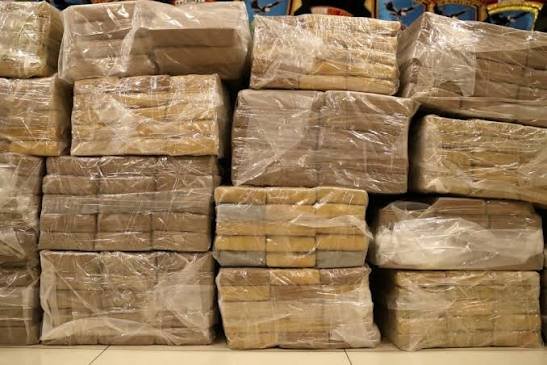
For a country that has spent years trying to strengthen its fight against illegal drugs, Ghana has had a particularly uncomfortable few months. Almost every few days, another drug-related story appears in the news. Large quantities of tramadol are intercepted at the ports. Suspected cocaine is seized. Young people are arrested over cannabis products. Drug suspects allegedly attempt to bribe police officers. And now, nearly four tonnes of cocaine reportedly shipped from Ghana have been seized thousands of kilometres away in France. Taken individually, these cases are serious. Put together, they raise a much bigger question: how deep has Ghana's drug problem really become?
One of the latest cases happened days ago when two men were arrested after allegedly attempting to bribe a police officer with GH¢30,000. According to the police, officers of the Bravo SWAT Unit had intercepted a Kia Rhino truck near Abofu, around Achimota, after receiving intelligence that it was allegedly being used to transport suspected narcotic substances from Kpandai in the Oti Region to Accra. The occupants reportedly fled when they saw the police, leaving the truck behind. A search allegedly uncovered 175 compressed slabs of dried leaves, concealed in sacks and Ghana Must Go bags. The story did not end with the seizure.
Two men later appeared at the police headquarters claiming ownership of the truck and the suspected drugs. Police allege that they then offered GH¢30,000 to the SWAT commander in an attempt to secure the release of the vehicle and the exhibits. The two were arrested and the alleged bribe money was retrieved. Investigations are continuing, including efforts to locate a third person who allegedly drove the truck.
It is a disturbing development because it shows that the drug problem may involve more than people transporting and selling narcotics. It can also create opportunities for corruption and attempts to interfere with law enforcement. But that case is only one part of a much larger picture.
Perhaps the most serious recent case is the seizure of nearly 3.9 tonnes of suspected cocaine by French customs authorities at the port of Dunkirk on September 10. The cocaine was reportedly concealed inside containers carrying plastic waste that had arrived from Ghana. French authorities estimated the value of the drugs at about €225 million, or roughly US$260 million.
The seizure immediately raised an uncomfortable question in Ghana: How did such a huge quantity of cocaine leave the country without being detected? The matter has already led to arrests in Ghana. Four Ghanaians were arraigned before the High Court in Accra over allegations connected to the shipment. A fifth accused person, Dutch national Jos Leijdekkers, also known as “Bolle Jos,” is reported to be at large. The accused persons have pleaded not guilty, and the allegations remain to be determined by the courts. The investigation has also brought attention to Ghana's port and Customs systems. Another report says six people were remanded in connection with the alleged export of the shipment, including four Ghana Revenue Authority employees whose alleged roles in the Customs scanning process are being investigated. Their arrest or involvement in the investigation does not by itself establish guilt.
This is where the issue becomes bigger than cocaine. If the drugs were already inside the containers when they left Ghana, then investigators have to establish how the containers passed through the country's export-control system. Was the container scanned? What did the scan show? Who examined it? Was there a failure in the system, or was someone deliberately helping the shipment through? Those questions are now central to the investigation.
But the problem is not only cocaine. While the French cocaine seizure has attracted international attention, Ghana has also been dealing with large quantities of other narcotics. In March 2026, Customs officials at Tema Port intercepted a huge consignment of undeclared tramadol. The scale was extraordinary: about 146.9 million tablets, weighing more than 34 tonnes. Nine public officers were arrested in connection with the case. Then in July, another approximately five million tramadol tablets, estimated to have a street value of about GH¢100 million, were intercepted at the Accra International Airport.
These seizures show that Ghana's drug problem is not limited to traditional substances such as cocaine and cannabis. Pharmaceutical drugs and synthetic substances such as tramadol and tapentadol have also become an important part of the trafficking problem. NACOC reported that during the period under review, its intelligence-led operations with partner agencies resulted in 217 arrests and 165 prosecutions, with more than 8.5 tonnes of assorted narcotic drugs and 45.4 million tramadol tablets intercepted. Those figures are difficult to ignore.
Perhaps the most worrying aspect of the situation is how drugs are finding their way into environments where young people are supposed to be building their futures. In August, NACOC arrested ten students of Koforidua Technical University over allegations involving the production, distribution and sale of cannabis-infused drinks and ice cream. The significance of that case goes beyond the number of students arrested. When narcotic substances can be incorporated into products that look like ordinary food or drinks, it becomes harder for parents, teachers and even other students to identify what is happening.
It also shows how quickly drug culture can adapt. NACOC has said enforcement alone cannot solve the problem. In 2026, the Commission reported that about 1,179 people affected by substance-use disorders received support through 30 treatment centres, while prevention and public education programmes reached approximately 495,000 people. That is important because not everyone involved with drugs is necessarily a major trafficker. Some are users who need treatment and rehabilitation, while others may be couriers or low-level participants working for people higher up the chain. The real challenge is identifying and dismantling the networks that finance and organise the trade.
The international dimension of the recent cases is perhaps the most uncomfortable part. A shipment leaving Ghana and being intercepted in France inevitably raises questions about Ghana's ports, borders and export-control systems. There are also concerns about what repeated international seizures could mean for legitimate Ghanaian businesses. If international authorities begin viewing shipments from Ghana as higher-risk, exporters could face more inspections, delays and costs. Ghana's reputation as a trading country could also be affected. That is why the France case is not simply a story about cocaine. It is also a story about trust.
Ghana cannot arrest its way out of the problem. If a drug suspect can allegedly walk into a police headquarters and offer GH¢30,000 to make evidence disappear, then the fight against drugs also becomes a fight against corruption within the system. The response must therefore involve the police, NACOC, Customs, the courts, schools, health professionals and communities.
The bigger question is how many trafficking networks can be identified, how many financiers can be brought before the courts, how much corruption can be prevented, and how many young people can be kept away from addiction in the first place. Ghana's drug problem is no longer something that can be discussed only in terms of police operations and dramatic seizures. It is a public health issue, a security issue, an education issue, a corruption issue and, increasingly, an international reputation issue.
And the consequences of failing to deal with it will be felt long after the headlines disappear.
Comments ()
Sign in to join the conversation
Sign InNo comments yet. Be the first to share your thoughts!
Comments will be loaded here...