
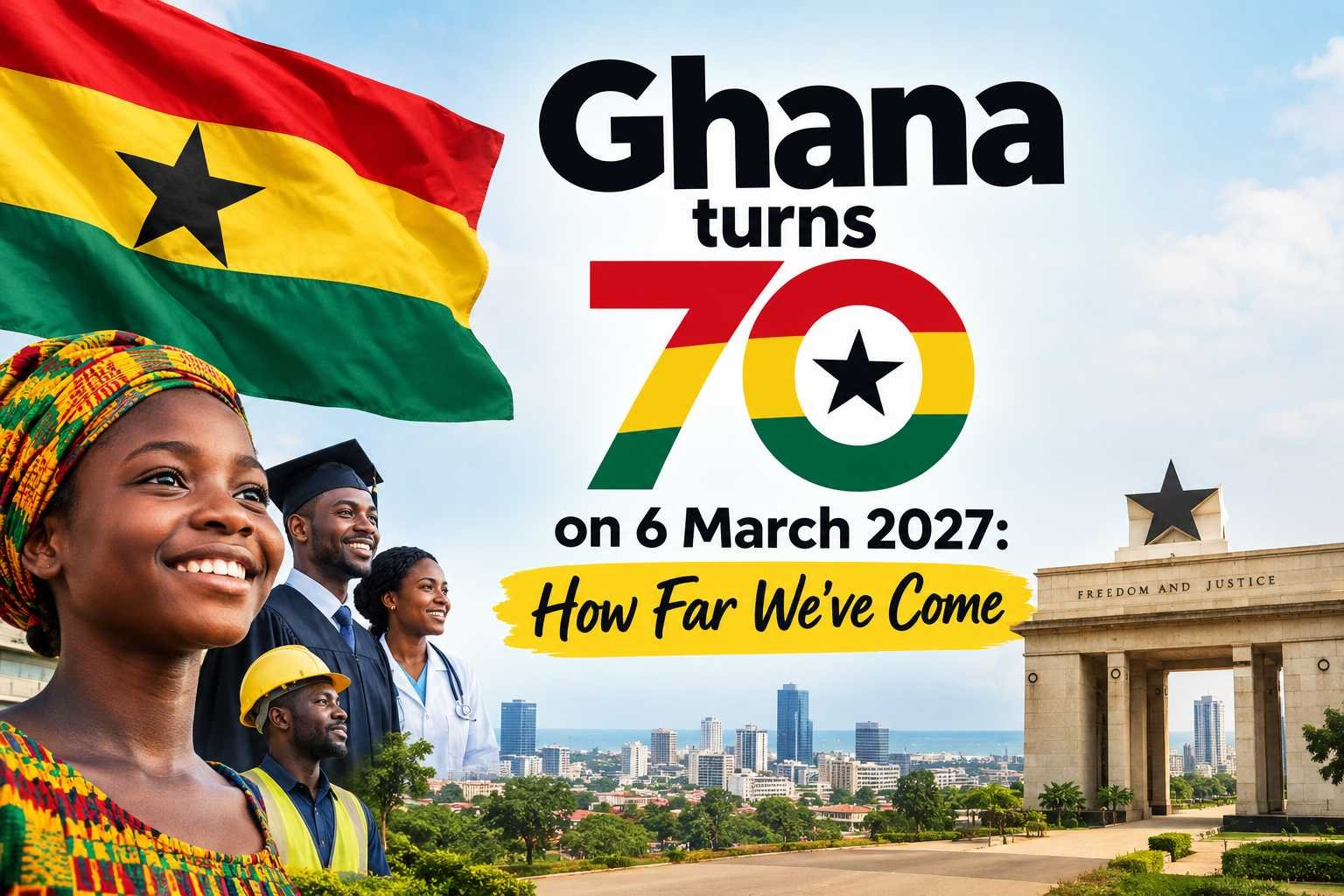
On 6 March 2027 Ghana marks 70 years since it became the first sub-Saharan African colony to win independence from Britain, in 1957. The honest verdict: Ghana has built one of Africa's most durable democracies and a far larger, more urban, more educated society, but it has not achieved the economic transformation its founders promised. Seven decades include four successful coups, two IMF-backed rescues in the last 15 years, a 2022 debt default, and, by late 2026, a strong recovery that now has to be turned into jobs.
This review uses current data from the IMF, World Bank, Bank of Ghana and Ghanaian press, and the long-run historical record. Where sources disagree, both figures are given. It does not take a party-political side: achievements and failures are attributed to the period in which they happened, across governments of both the NDC and NPP traditions.
Country preparations for the anniversary are already visible, from Accra road resealing to hosting the 2027 U-20 AFCON, for which the National Sports Authority admits no stadium currently meets CAF standards.
Where Ghana stands in late 2026
Ghana is in its strongest macroeconomic position in a decade, but the recovery has not yet reached the jobs market. The economy grew 6.0% in 2025, inflation fell from above 23% in 2024 to single digits, and Ghana completed its IMF bailout in July 2026. Youth unemployment and illegal mining remain the two problems most visible to ordinary Ghanaians.
Indicator | Latest figure | Context | Source |
|---|---|---|---|
Population | 33.7 million (2025 est.) | 6.7 million at the 1960 census; 30.8 million in 2021 | |
GDP growth | 6.0% (2025); 6.2% first half of 2026 | IMF projects 5.7% for 2026 (Oct WEO); World Bank holds 4.8% | |
Inflation | About 3.2% (March 2026) | Average 31.9% in 2022; IMF projects 4.8% end-2026 | |
Public debt | 45.3% of GDP (end-2025) | Peaked at about 93% in 2022 before default | |
Fiscal balance | Primary surplus 2.6% of GDP (2025) | Primary deficit in 2024 | |
Reserves | About US$14.5 billion (Feb 2026) | Almost six months of import cover | |
Cedi | About GH¢11.7 per US$ (BoG interbank, mid-Oct 2026) | Forex bureaus sell near GH¢12.30 | |
Credit rating | Moody's B3 (upgraded 9 Oct 2026) | Up from Caa1 | |
IMF status | US$3bn ECF completed July 2026 | Now a non-lending 36-month Policy Coordination Instrument | |
Unemployment | 12.8% national; 21.9% for ages 15–35 (Q1–Q3 2025) | Greater Accra youth rate 31.9%; nearly 2 million youth NEET |
Two cautions keep this picture honest. First, the 2026 recovery follows the 2022 collapse, so part of the growth is a rebound from a low base. Second, the IMF itself flagged delays in structural reforms and urged the government to keep the momentum after exit (IC Securities). Ghana has stabilised before, in 2015–2019, and slid back.
The 10 turning points, 1957 to 2026
These are the events that changed Ghana's direction, not just its headlines. They are chosen for lasting impact on how Ghana is governed, how it earns its living, and how its people live. Dates and figures without a link come from the standard historical record.
1. Independence, 6 March 1957
What happened: The Gold Coast became Ghana under Kwame Nkrumah, the first sub-Saharan colony to break from European rule. It became a republic in 1960.
Why it mattered: Ghana became the symbol and launchpad of African liberation, hosting freedom fighters and pushing for continental unity that fed into the Organisation of African Unity in 1963.
Lasting impact: A strong national identity and pan-African standing that still give Ghana diplomatic weight, including its election in February 2026 as first Vice-Chair of the African Union.
2. The Akosombo Dam and state-led industrialisation, 1961–1966
What happened: Nkrumah's Volta River Project built the Akosombo Dam, creating Lake Volta, alongside Tema harbour and township, and dozens of state factories.
Why it mattered: It gave Ghana cheap hydropower and an industrial base unmatched in West Africa at the time. It also ran down the large reserves inherited at independence and left debt.
Lasting impact: Hydro from Akosombo and Kpong supplied almost all of Ghana's electricity until the 1980s (Citi Newsroom). Many state factories later failed, a pattern of big projects outrunning management capacity that recurs.
3. One-party state and the 1966 coup
What happened: A 1964 referendum made Ghana a one-party state. On 24 February 1966 the army and police overthrew Nkrumah while he was abroad.
Why it mattered: It opened a 15-year cycle of coups (1966, 1972, 1979, 1981) and short-lived civilian governments. No elected government between 1966 and 1992 finished a full term.
Lasting impact: Political instability helped drive an economic decline that cost a generation. It is the main reason Ghana's institutions are younger than its flag.
4. The economic collapse of the 1970s and the Rawlings coups, 1979 and 1981
What happened: Under military rule in the 1970s, cocoa output fell, smuggling and shortages ("kalabule") spread, and inflation ran above 100%. Jerry Rawlings led a junior officers' uprising in June 1979, handed power to a civilian government, then seized it again on 31 December 1981.
Why it mattered: The 1979 period included executions of former heads of state; the PNDC era brought both discipline and serious human-rights abuses, later examined by the National Reconciliation Commission.
Lasting impact: The collapse discredited heavy state control of the economy, and the period remains politically contested, which is why accounts of it differ sharply along party lines.
5. The 1983 Economic Recovery Programme
What happened: After drought, bushfires, famine and the expulsion of about a million Ghanaians from Nigeria in 1983, the PNDC adopted an IMF and World Bank-backed recovery programme in April 1983 (ODI).
Why it mattered: The cedi was devalued, prices were freed and cocoa producers were paid more. Inflation had been over 100% (GNA); growth returned through the late 1980s and Ghana became a showcase for structural adjustment.
Lasting impact: It set Ghana's market-based economic model. It also cut public-sector jobs and raised user fees, a social cost that created the template for later IMF debates.
6. The Fourth Republic Constitution, 1992
What happened: A referendum in April 1992 approved a new constitution; the Fourth Republic began on 7 January 1993 with multiparty elections.
Why it mattered: It created term limits, an independent judiciary and Electoral Commission, and a free press after the repeal of criminal libel in 2001.
Lasting impact: Over 33 years it is the longest constitutional period in Ghana's history. Critics argue it concentrates too much power in the presidency, with ministers drawn from Parliament and the president appointing district chief executives.
7. The first peaceful transfer of power, January 2001
What happened: The NPP's John Kufuor defeated the NDC's John Atta Mills in 2000, and Rawlings's party handed over power.
Why it mattered: It proved the system could change governments at the ballot box. Since then power has changed hands in 2009, 2017 and 2025, and the narrow 2008 run-off and the 2012 Supreme Court election petition were settled by institutions, not violence.
Lasting impact: Ghana's reputation as a stable democracy, its main asset in a region that has seen coups in Mali, Burkina Faso, Niger and Guinea since 2020. The same period also brought HIPC debt relief from 2001.
8. Oil discovery and middle-income status, 2007–2010
What happened: Commercial oil was announced at the offshore Jubilee field in June 2007, during the 50th independence year, and first oil was inaugurated on 15 December 2010 (Graphic). The same year, a GDP rebasing raised estimated per-capita income by about 70% and moved Ghana into the lower-middle-income group (IMF).
Why it mattered: Oil overtook cocoa as an export by 2012 (Oxford Business Group), and middle-income status opened access to Eurobond markets.
Lasting impact: The "new rich" status ended much cheap concessional borrowing, and commercial debt rose fast. Projected oil windfalls were lower than hoped. This links directly to the 2022 crisis.
9. Free Senior High School, September 2017
What happened: The Akufo-Addo government made public senior high school free, including boarding and meals.
Why it mattered: Enrolment rose from about 813,000 in 2016/17 to about 1.3 million in 2022/23 (Adom / Eduwatch). Gains were largest for poorer households, especially girls in rural areas (UG CSPS).
Lasting impact: It is now broadly accepted across parties, but funding has lagged: Eduwatch reports budget releases falling well short of needs, and a double-track system was needed to fit students in. Its graduates now feed straight into the youth jobs problem.
10. Default, IMF rescue and recovery, 2022–2026
What happened: After COVID-19, heavy borrowing and global rate rises, public debt hit about 93% of GDP. Ghana launched a domestic debt exchange on 5 December 2022 and suspended most external debt payments on 19 December 2022 (Al Jazeera), then took a US$3 billion IMF loan in May 2023.
Why it mattered: Pensioners, banks and bondholders took losses, inflation peaked above 50% in late 2022, and the cedi lost much of its value. Voters removed the NPP in December 2024 and returned John Mahama.
Lasting impact: Ghana completed the IMF programme in July 2026 with debt down to about 45% of GDP (IMF via Gazette). It was Ghana's 17th IMF programme (GNA), which is the clearest sign of how hard lasting stability has been.
The balance sheet: what worked and what did not
Ghana's clearest success is political; its clearest failure is economic transformation. The country has kept a democracy through four changes of ruling party, but still depends on raw exports (gold, cocoa, oil) and has needed IMF support 17 times.
Area | Real progress | Persistent shortfall |
|---|---|---|
Democracy and rights | Four peaceful handovers of power since 2001; election disputes settled in court; lively media and civil society | Winner-takes-all presidency; deep NDC–NPP polarisation; corruption scandals under every government |
Economy | Economy many times larger; lower-middle-income status since 2010; 2025–26 recovery with single-digit inflation | Boom–bust cycles; 17 IMF programmes; little manufacturing; growth tied to gold, cocoa and oil prices |
Education | Free basic and senior high education; SHS enrolment up about 60% since 2016/17 | Learning quality, teacher shortages and funding gaps; graduates without jobs |
Jobs | Large services and digital sector, including mobile money | Youth unemployment 21.9%, Greater Accra 31.9%; nearly 2 million young people not in work or training (GSS) |
Environment and resources | Bans on mining in forest reserves; river restoration studies started | Illegal mining (galamsey) has polluted rivers and cocoa land; enforcement keeps failing (Starr FM) |
Infrastructure and power | Akosombo, Tema port, national grid, wide electrification since the 1990s | Recurring power crises ("dumsor"); stadiums not up to CAF standard; congested cities |
Regional standing | Pan-African leader; stable anchor amid Sahel coups | Rising security threats from Sahel extremism and maritime crime, flagged by the Chief of Defence Staff (Citi Newsroom) |
Galamsey shows the difficulty most clearly. President Mahama has called it a national emergency but declined to declare a formal state of emergency, which campaigners criticise (Citi Newsroom). Researchers point to corruption and the fact that mining pays far more than farming in affected communities, so force alone has not worked.
Questions for the next decade
The test after 70 years is whether Ghana can stay stable without an IMF anchor and turn growth into jobs. Five questions will decide it:
- Can fiscal discipline survive without the IMF? Ghana now runs a non-lending Policy Coordination Instrument and a new fiscal council. Past recoveries unravelled in election years.
- Can the economy add value at home? The government's planned "New Economy" framework and the 24-hour economy programme aim at processing and jobs (GNA); results are not yet measurable.
- Can the state win the galamsey fight? Clean water and the cocoa sector depend on it.
- Can education deliver skills, not just seats? Free SHS solved access; quality and job-readiness are the next problem.
- Can the 1992 Constitution be reformed by consensus? Calls to reduce presidential power and depoliticise the Electoral Commission recur after every election.
One honest reading of 70 years: Ghana's political institutions have matured faster than its economy. Whether the 2026 recovery is a lasting break or another cycle will be the story of Ghana at 80.
Sources
- IMF projects 5.7% growth for Ghana in 2026 — GNA
- IMF raises Ghana's 2026 growth forecast — MyJoyOnline
- IMF: Ghana among stronger performers — Daily Graphic
- IMF revises Ghana's 2026 growth — Ghanaian Times
- Ghana enters sixth IMF review — Ecofin Agency
- Ghana exits IMF programme — Gazette (IMF press release)
- Ghana successfully exits IMF bailout programme — GNA
- Beyond financial support — IC Securities
- Cedi rates, 15 October 2026 — ModernGhana
- More than one-third of Ghana's population is youth — Ghana Statistical Service
- Nearly 2 million young Ghanaians NEET — Daily Graphic
- Accra roads facelift for Ghana@70 — MyJoyOnline
- No venue ready for 2027 U-20 AFCON — AfricaSoccer
- Adjustment in Africa: Lessons from Ghana — ODI
- Rawlings' legacy: economic reforms — GNA
- Rawlings legacy in the energy sector — Citi Newsroom
- Oil and gas activities in Ghana — Daily Graphic
- Hydrocarbons have reshaped the economy — Oxford Business Group
- IMF Article IV, 2011 (GDP rebasing) — IMF
- 2.5 million students benefited from Free SHS — Adom / Eduwatch
- Is Free SHS free for all? — University of Ghana CSPS
- Ghana suspends payment of most external debts — Al Jazeera
- Galamsey study — Starr FM
- Mahama's galamsey response — Citi Newsroom
- Galamsey worsening — Citi Newsroom
Comments ()
Sign in to join the conversation
Sign InNo comments yet. Be the first to share your thoughts!
Comments will be loaded here...