
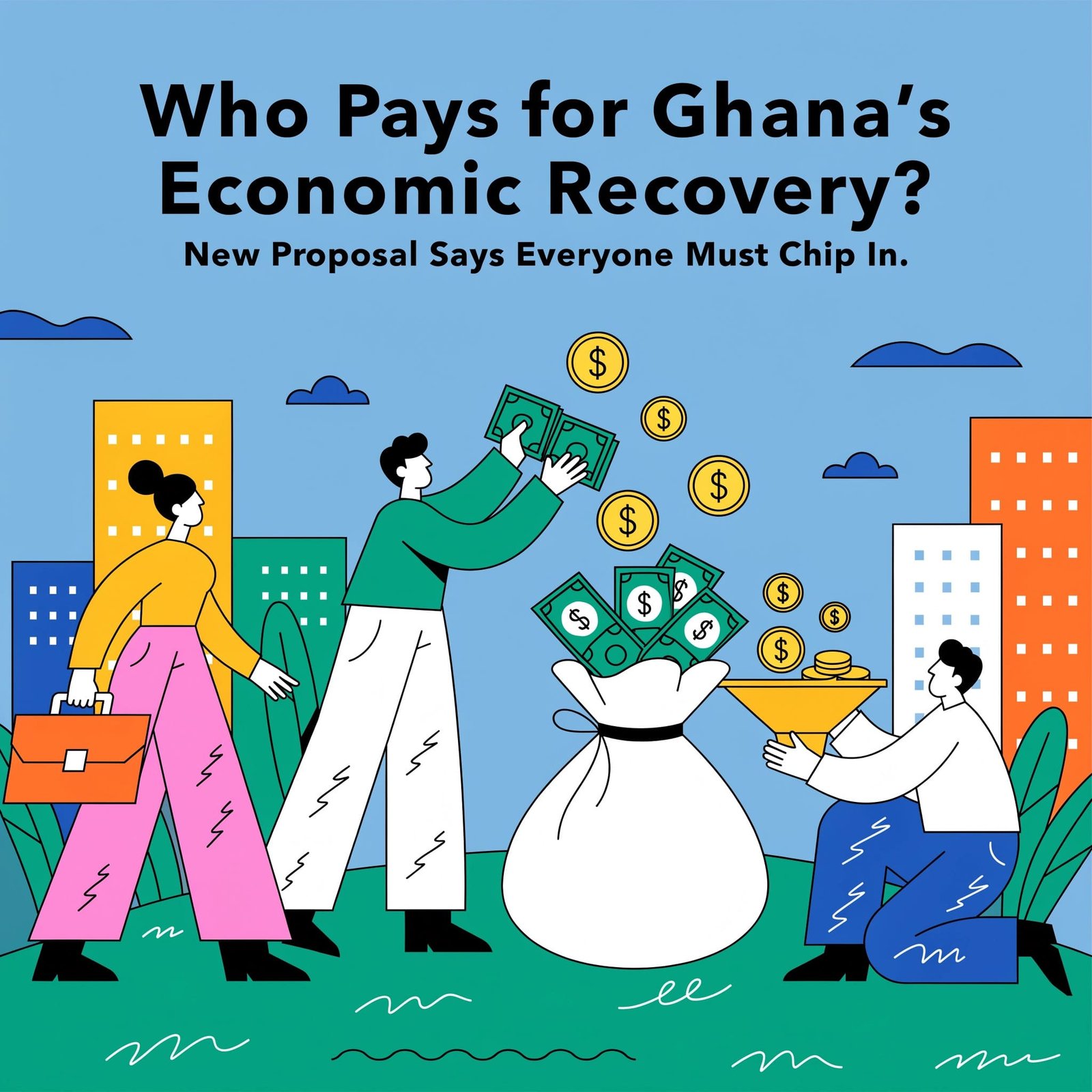
For years, Ghana's development has followed a familiar pattern: the government borrows, the government builds, and the government pays the bills. A new policy proposal says that model has simply run out of road.
After years of heavy debt, a shaky cedi and deep problems in how the economy is structured, the proposal argues that no single group can carry the load anymore. Its central question is a blunt one: who should pay the price for fixing the economy?
Its answer is everyone, but in different ways.
The government: spend less, spend smarter.
The proposal puts the first and heaviest responsibility on the state. The thinking is simple. Government cannot ask workers and businesses to tighten their belts while its own spending stays bloated.
That means strict limits on public debt, cutting waste and reducing the cost of running government. It also means the state focusing its money on the basics that only it can provide well: security, basic education, healthcare, core infrastructure and a working justice system.
Perhaps the biggest shift is in the government's role. Instead of acting as the country's main builder and employer, the proposal wants the state to step back and create a calm, predictable environment for business, with low inflation, a stable cedi and sensible taxes.
Businesses: invest, process and pay fair taxes.
For the private sector, the proposal calls for a move away from simply importing goods and reselling them. Instead, it wants more Ghanaian companies processing farm produce, minerals and industrial materials here at home.
It also asks businesses to pay their fair share of tax consistently, rather than leaning on exemptions or informal shortcuts. And it wants private firms to stop waiting on government contracts and payments, and start putting their own money into public infrastructure projects that can earn a return.
Citizens: pay tax, buy local, speak up.
Ordinary Ghanaians also have a part to play. The proposal says more people, especially those in the informal sector and small digital businesses, need to come into the tax system so the country depends less on foreign loans.
It also encourages people to buy more Ghanaian-made goods, learn skills that match what industry needs, and hold their district assemblies and national leaders accountable for how public money is used.
The model: produce more, borrow less.
The proposal describes its preferred approach as a "production-led developmental state." In plain terms, the government sets the rules and keeps things stable, while private money and partnerships do much of the building and producing.
It rests on four main ideas.
Private money for big projects. Instead of taking loans for commercial projects like toll roads, ports, power plants and housing, the government would bring in private investors alongside low-cost development funding. Those investors would build and run the projects, then recover their money through clear and transparent user fees.
Process before we export. Ghana would move away from selling raw cocoa, unrefined gold and crude oil, and do more of the refining and processing locally. Agro-industrial hubs would be set up close to farming communities, with tax incentives for processing plants that locate there.
A wider, fairer tax net. Rather than squeezing the small group of businesses that already pay tax, the government would use digital payments, the national ID system and digital property addresses to bring more of the informal economy into the tax system.
Regions that grow on their own. District Assemblies would be given real power to act as local economic zones, attracting investors based on each area's own natural resources, instead of functioning mainly as administrative offices.
What has to happen first.
The proposal is honest that none of this works without some hard conditions being met.
First, long-term national plans need to survive changes in government. A strategy that gets abandoned every time a new president takes office will not deliver results.
Second, corruption has to be tackled seriously, with strong and regular auditing of public procurement. The argument here is that people will only accept paying more tax if they trust the money is being used well.
Third, Ghana needs deeper local capital markets, so that pension funds and other local savings can finance long-term infrastructure, instead of the country relying on foreign-currency debt that becomes more expensive whenever the cedi weakens.
The other side of the argument.
Not everyone will be convinced. Critics of public-private partnerships often point out that user fees on roads, power and other services can hit low-income households hardest, and that poorly negotiated deals have left governments elsewhere carrying hidden costs when projects underperform.
Others may question whether pushing more of the informal sector into the tax net is fair while many traders and small business owners are still struggling with high living costs. And some will argue that the state still needs to play a bigger direct role in creating jobs and building infrastructure, especially in areas private investors find unprofitable.
A shared bill for a shared future.
The message of the proposal is clear: the era of borrowing to fund everything is over, and the bill for recovery has to be shared. Government pays through discipline, businesses through investment, and citizens through compliance and productivity.
Whether that vision becomes reality will depend less on the plan itself and more on whether leaders can keep it going across elections, and whether Ghanaians come to trust that their sacrifices will be matched by those at the top.
Does this sound like a good plan? Let us know what you think in the comment section.
Comments ()
Sign in to join the conversation
Sign InNo comments yet. Be the first to share your thoughts!
Comments will be loaded here...