
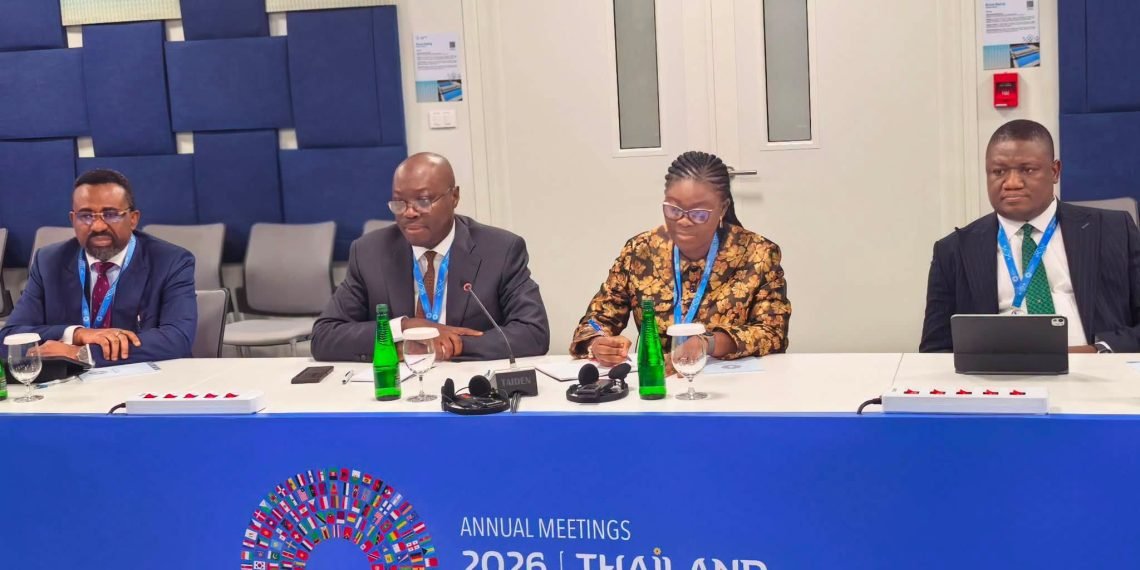
The assessment was made by Zeine Zeidane, Director of the IMF’s African Department, during the Fund’s 2026 Annual Meetings in Bangkok, Thailand, where he expressed confidence in Ghana’s recent economic performance.
Mr. Zeidane said Ghana had made progress in strengthening its economy following the successful completion of its Extended Credit Facility (ECF) programme and the transition to a new phase of reforms under the Policy Coordination Instrument (PCI).
He noted that Ghana’s recent sovereign credit-rating upgrades reflected improvements in economic management and suggested that the country was moving in the right direction.
Although fluctuations in global commodity prices could pose risks, particularly for countries that depend heavily on commodity exports, Mr. Zeidane said Ghana was entering the period from a stronger position.
IMF Raises Ghana’s Growth Forecast
The IMF has revised its projection for Ghana’s economic growth in 2026 from 4.6 per cent to 5.7 per cent, reflecting stronger-than-expected economic activity and improved macroeconomic conditions.
The Fund said Ghana’s economy grew by 6.2 per cent in the first half of 2026 and expected the momentum to continue into the second half of the year.
The improved outlook has been supported by relatively strong gold prices, contained inflation and better fiscal performance. Gold remains a major source of export earnings and foreign exchange for the country.
However, the IMF expects economic growth to moderate to 5.2 per cent in 2027, partly because weaker global demand could affect Ghana’s performance as a net importer.
Commodity Dependence Remains a Risk
Despite the positive assessment, the Fund has cautioned that Ghana remains exposed to changes in international commodity prices.
Gold has played a significant role in strengthening the country’s external position, but a substantial fall in prices could reduce export earnings and foreign exchange inflows.
Such a development could also place pressure on government revenue, the balance of payments and the country’s capacity to sustain its economic recovery.
The IMF’s assessment therefore highlights the importance of maintaining economic reforms and building sufficient buffers to protect the country against external disruptions.
Government Urged to Sustain Reforms
The improved outlook follows measures aimed at restoring fiscal discipline, strengthening public financial management and stabilising the economy.
The IMF has stressed the need for Ghana to maintain these efforts under the Policy Coordination Instrument, which provides a framework for economic policy guidance and monitoring without the financing attached to a traditional lending programme.
Finance Minister Dr Cassiel Ato Baah Forson has reaffirmed the government’s commitment to fiscal discipline, productivity-enhancing reforms and measures intended to attract investment and create jobs.
The government has also expressed confidence that Ghana could exceed the IMF’s revised growth forecast for 2026.
While the Fund’s assessment signals growing confidence in Ghana’s economic direction, sustaining the gains will depend on continued prudent economic management, stronger domestic revenue mobilisation and efforts to reduce the country’s vulnerability to fluctuations in global commodity markets.
Comments ()
Sign in to join the conversation
Sign InNo comments yet. Be the first to share your thoughts!
Comments will be loaded here...