
FIGHTING FOR THE FUTURE: GHANA’S BATTLE AGAINST ILLEGAL MINING
It is nerve-racking, disheartening and almost disillusioning that after eight years of waging a battle against illegal mining, known locally as galamsey, we are still not out of the woods yet.
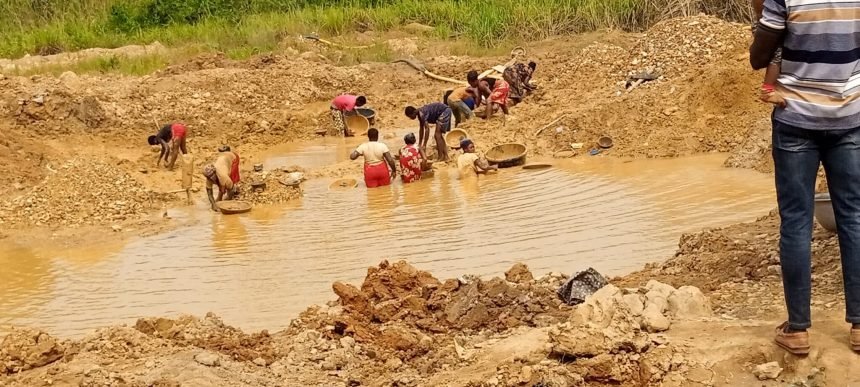
The country’s major rivers such as the Pra, Ankobra, Offin, Densu, Tano, that have been a source of livelihood for millions of Ghanaians have been reduced to nothing as galamsey operators stir up their bellies and inject poisonous chemicals such as mercury and cyanide into them in the desperate search for gold. Large tracts of arable land that served that agricultural needs of the people in mining communities have been reduced to nothing while several acreage of cocoa farms have been destroyed by illegal miners. The least said about the pillaging of forest reserves across mining regions in the country the better.
“As a journalist who has devoted time to environmental reporting, I have been to almost every mining community across the country in the last eight years, I weep for this country.
This vivid account by Timothy Ngnenbe, an environmental and climate change journalists at the Daily Graphic, sums up the devastating effect of galamsey on the environment and leaves a lot of questions begging for answers.”
Mr Ngnenbe has been one of the foremost Ghanaian journalists who put their lives on the line as they combed every nook and cranny of the country to shed the light on galamsey and its devastating effects on the environment and humanity.
When our team sat with him for an interview on this all-important national development challenge, there were moments of dead silence and at times, a combination of dejection, despair, and fear gripped us as he recounted harrowing experiences in his line of duty.
"I have a scar on my elbow (he points to it). I fell into an uncovered galamsey pit at Kyebi in the Eastern Region in 2017 during one of trips to the area with the Minister of Lands and Natural Resources at the time, John Peter Amewu. On many occasions, illegal miners opened fire on our team and we had to lie flat on the ground to avoid being hit by a bullet. The one which happened at the Oda River Forest Reserve in the Ashanti Region was the scariest of them all; but thank God, we survived it," he said.
The galamsey fight
Just like Mr Ngnenbe, many other journalists including Multimedia Group Limited's Erastus Asare Donkor; Citi FM's Bernard Koku Avle and Umaru Sanda Amadu; Environmental News Editor at Ghana Broadcasting Corporation (GBC), Ebenezer Joshua Ayree have all been known voices in the anti-galamsey fight.
They have used the power of their microphones and big platforms to rally stakeholders to collectively fight against illegal mining and other environmental crimes.
Apart from putting their lives on the line to tell compelling stories on the galamsey menace, the works of these journalists have been used by many environmental civil society organisations (CSOs) for advocacy and calling duty bearers to action.
In 2017, the previous government put an almost two-year ban on all forms of small-scale mining in a bid to sanitise the mining sector. An inter-ministerial committee on illegal mining was also formed to coordinate and roll out policies and measures to fight the menace. Subsequently, a military deployment, dubbed “Operation Vanguard”, was launched and sent to hotspots to flash out illegal miners.
Many other measures were rolled out by the government, including the National Alternative Employment and Livelihood Programme (NAELP) to help stop galamsey.
Effects
In spite of the loud noise about illegal mining activities in the country over the past eight years, the illegality seems to have reached the crescendo as land and water resources continuous to be destroyed with impunity.
For instance, a State of the Nation’s Forest report by the Forestry Commission on May 2, 2023, indicated that 392,714.81 hectares of the country’s 288 forest reserves had been significantly impacted by illegal mining activities, out of which 4,726.26 hectares in 34 of the reserves had been confirmed destroyed.
In 2024, the Centre for Remote Sensing and Geographic Information Services through the SERVIR West Africa programme, revealed that more than 670 square kilometers of land had been destroyed by illegal mining.
Experts have also warned that if immediate steps were not taken to halt the pollution of waterbodies through illegal mining activities, Ghana risked importing water in the next five years.
Research has also established several birth defects in children in mining communities, giving indication that the health implications of galamsey are more than meets the eye.
The big issues
For Mr Ngnenbe, the incessant spate of galamsey in the country could be linked to a multiplicity of factors ranging from weak enforcement of the country’s mining laws by regulatory agencies, overly politicisation of galamsey, failure on the part of chiefs to play their oversight roles as custodians of the land, lack of political will by the government to fight the menace, to inadequate awareness creation and education in the long-term effects of galamsey.
There have been many reports of persons arrested for illegal mining being allowed to go free. Many anti-galamsey advocates have blamed the police for being complicit in some of those cases while others said the court systems have not been proactive in handling illegal mining cases.
Way forward
There is the need for stronger collaboration among stakeholders to halt illegal mining activities and also ensure that recalcitrant galamseyers are severely dealt with.
For Mr Ngnenbe, the current government must send a strong signal of its readiness to tackle the galamsey menace head-on by ensuring that anyone caught in the web were drastically dealt with according to the law.
“My works on illegal mining have won me several awards, including three-time winner of mining category of the prestigious Ghana Journalists Association (GJA) Awards, four-time winner of the Mining Reporter of the Year at the Ghana Mining Industry Awards (GMIA) by the Ghana Chamber of Mines. Although these awards are gratifying, for me, the real gratification lies in seeing that through your stories, duty bearers are taking action and rolling policies to protect the people and the planet, especially so when the global climate crisis is biting us hard,” he said.
As a result, he called on the current government to walk the talk in the galamsey fight by ensuring that watertight measures were put in place to halt all forms of illegal mining, particularly in waterbodies and forest reserves.
Again, he stressed the need for all persons found to be engaged in galamsey to be severely dealt with according to the law irrespective of their political colours or status in society.
Galamsey is a canker that has dire consequences for sustainable development. The government alone cannot fight and win the galamsey battle. There is the need for the active involvement of chiefs in fighting this environmental crime. When chiefs speak, the listen; so if they truly want galamsey to stop, it can be done.
Photo credit: The fourth Estate
Comments ()
Sign in to join the conversation
Sign InNo comments yet. Be the first to share your thoughts!
Comments will be loaded here...