

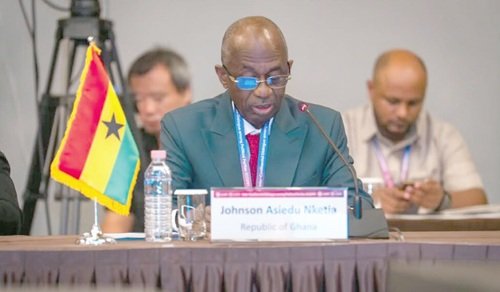
National Chairman of Ghana’s National Democratic Congress (NDC), Johnson Asiedu Nketiah, has challenged political parties to confront declining public confidence in politics and take deliberate steps to rebuild trust with citizens.
Speaking at the inaugural Inter-Continental Dialogue on Political Parties in Seoul on September 7, 2026, Mr Asiedu Nketiah said political organisations could no longer depend solely on historical loyalties, ideological traditions or past achievements to retain public support.
He argued that every generation assesses political institutions against its own social and economic realities, making it increasingly important for parties to demonstrate their relevance to citizens.
His remarks were delivered on behalf of political parties participating in the African Political Parties Initiative (APPI), at a gathering involving the Africa Governance Centre, the International Conference of Asian Political Parties (ICAPP) and the Permanent Conference of Political Parties of Latin America and the Caribbean (COPPPAL).
Public confidence cannot be taken for granted
Mr Asiedu Nketiah stressed that political parties must recognise that public confidence has to be continually earned.
“Public confidence cannot be taken for granted,” he said, according to reporting by Adomonline.
He linked declining confidence in political institutions to the everyday experiences of citizens, particularly young people facing unemployment, economic insecurity, rising living costs and uncertainty about their economic prospects.
For him, when citizens fulfil their responsibilities to society but see little improvement in their living conditions, frustration can evolve into a broader loss of faith in political institutions.
He urged political parties to treat such public dissatisfaction as an institutional warning rather than simply dismissing it as temporary political discontent.
A major theme of Mr Asiedu Nketiah’s address was the distinction between winning elections and being prepared to govern.
He argued that the quality of a future government is shaped inside political parties long before election day — through the people parties promote, the qualities they reward, the policies they develop and the conduct they tolerate.
Political parties, he said, must therefore invest in leadership development before individuals are given the opportunity to assume public office.
He cautioned that electoral strength should not automatically be interpreted as evidence of governing competence. A party may be effective at mobilisation and campaigning while lacking the institutional depth and policy capacity necessary to manage the complexities of government.
The NDC National Chairman also called on political parties to examine their own failures rather than routinely attributing setbacks to their opponents. Electoral defeats, declining membership and public disaffection, he argued, can expose weaknesses that prolonged political success may conceal.
Parties that are prepared to examine why citizens have withdrawn their confidence, he suggested, are better positioned to renew themselves and remain relevant. He also stressed the importance of developing successive generations of leaders so that political transitions do not become institutional crises.
Mr Asiedu Nketiah said political parties now operate in a significantly more demanding environment than the one in which many were established. Citizens have greater access to information, more opportunities to organise outside traditional political structures and greater exposure to competing political ideas.
That changing environment, he argued, means established parties must do more than preserve their traditional identities. They must continually demonstrate why they remain relevant to the political future.
The enduring measure of a political party, he suggested, should therefore go beyond its ability to win an election. It should include the quality of leaders it produces, the strength of the institutions it builds and the political culture it leaves for succeeding generations.
Photo courtesy: Johnson Asiedu Nketia, Graphic online.
Comments ()
Sign in to join the conversation
Sign InNo comments yet. Be the first to share your thoughts!
Comments will be loaded here...